
Choose Threaded Fasteners by the Connection, Not the Head
How this site is written
Dimensions and compatibility depend on the exact fastener, material, tool, and manufacturer. We show the matching logic and name the source; verify the packaging and tool manual before drilling or driving.
Compare screws, bolts, studs, nuts and threaded inserts. Match the thread, material, hole and driver before choosing a fastener.
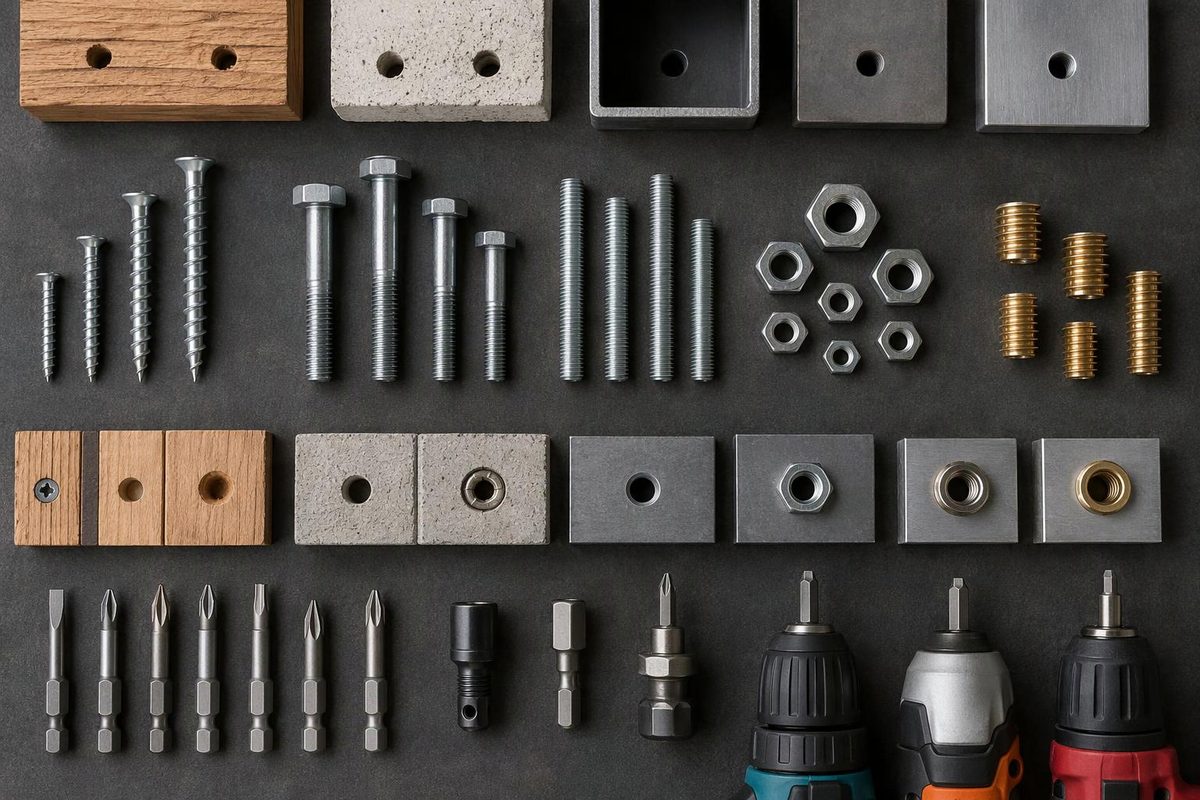
Threaded fasteners use a helical thread to secure or join parts. They include externally threaded screws, bolts and studs, plus internally threaded nuts and inserts. Some engage an existing matching thread; others create a thread in the material during installation.
Choose the connection first: will the fastener engage a nut, an existing threaded hole, or the material itself? A hex head, Phillips recess or Torx drive tells you how to turn a fastener—not what material or mating thread it fits.
Main types of threaded fasteners
These categories describe different features and sometimes overlap. For example, a self-drilling screw is also a screw that makes its own mating thread.
| Type | Where the thread engages | Selection starting point |
|---|---|---|
| Wood screws and lag screws | Directly in wood | Match the screw design to the wood, required penetration and hole preparation. A “lag bolt” has wood threads, not threads for a conventional machine-thread nut. |
| Machine screws | A matching nut or pre-threaded hole | Match thread system, diameter and pitch before selecting length and head style. |
| Bolts | Commonly a nut; some, including hex bolts, also fit tapped holes | Check the complete bolt-and-nut specification and access for tightening. Do not identify the thread by wrench size. |
| Self-tapping screws | Create a mating thread in suitable material | Check the substrate and specified starting hole. “Self-tapping” does not necessarily mean “no drilling.” |
| Self-drilling screws | Drill a starting hole and create the mating thread | Match the drill point to the material and permitted thickness range. |
| Studs and threaded rod | Nuts or matching internal threads | Useful where the connection calls for a headless threaded member. Fully threaded studs commonly work with two nuts, or a nut and a tapped hole. |
| Nuts and threaded inserts | Receive an externally threaded fastener | Nuts need a matching thread; inserts provide an internal machine thread in the selected substrate. |
The screw, bolt and nut distinctions above follow Bolt Depot’s fastener type chart. Its references also describe fully threaded studs and rod, and distinguish wood inserts from rivet nuts for thin sheet material.
Washers are companion hardware, not threaded fasteners. A flat washer spreads the load beneath a head or nut; it does not create a mating thread. Bolt Depot’s washer chart identifies different washer functions.
Choose by what receives the thread
Existing nut or threaded hole
Identify the existing thread rather than selecting a screw that looks close. Record:
- Thread system: metric or the relevant inch-thread system, such as Unified.
- Nominal diameter: normally the outside, or major, diameter of the thread—not the head width.
- Pitch or thread count: metric pitch in millimetres; Unified inch thread count in threads per inch (TPI).
- Length and available engagement: enough usable thread for the specified connection, without bottoming out in a blind hole.
For example, M6 × 1.0 × 30 describes a 6 mm nominal diameter, 1.0 mm pitch and 30 mm length. 1/4-20 × 2 in. describes a 1/4 in. nominal diameter, 20 TPI and 2 in. length. These are identification examples, not interchangeable sizes. See Bolt Depot’s notation guide.
Do not assume a universal engagement depth: Bossard’s thread-engagement guidance explains that the minimum needed for full load-bearing capacity depends on the component material’s strength. For detailed measurement and hole selection, use the machine screw guide.
Direct fastening into wood or sheet material
Select a fastener intended for that substrate. A wood screw, metal-tapping screw and machine screw are not equivalent merely because their outside diameters appear similar.
Keep three hole functions separate:
- A clearance hole lets the fastener pass through a part without engaging it.
- A tap-drill hole is prepared before cutting an internal machine thread with a tap.
- A pilot hole, in direct screw fastening, prepares the material for a screw that engages it directly.
Use the selected fastener’s installation data for hole diameter and depth; nominal screw diameter alone is not a drilling instruction. TR Fastenings’ hole chart lists tapping and clearance holes separately—they serve different purposes.
For metal-tapping screws, predrilling may still be required: EJOT’s self-tapping range forms threads in pre-drilled holes. Self-drilling points also have limits. EJOT’s drilling-capacity guidance warns that insufficient capacity can stop drilling, while a point intended for thicker components can weaken holding force in thin material. Use the self-drilling screw guide for that selection branch.
Check the complete assembly before buying
Strength and exposure: match the specified grade or property class, base metal and coating—not just size. Wetness, salts, treated wood and dissimilar metals can change corrosion requirements. Simpson Strong-Tie’s corrosion guidance calls for application-specific selection using both corrosion resistance and mechanical properties. For structural hardware, follow the connector’s approved fastener schedule; see why deck screws do not replace joist-hanger fasteners.
Length and seating: account for the parts and any specified washers or nuts. Most projecting-head fasteners are measured from under the head; countersunk flat-head screws include the head in their length. Special forms need their own drawings. See Bolt Depot’s length-measurement guide.
Driver and tightening: match the exact recess profile and bit size, or the actual hex-head wrench size. Confirm that the chosen tool and tightening method are permitted by the fastener or assembly instructions.
Before ordering, write one complete specification: fastener type + thread system and size + length + head and drive + grade/material/coating + mating hardware + hole preparation. If one of those remains unknown, resolve it before substituting a look-alike.