
A Hex Head Does Not Tell You Which Screw You Have
Identify a hex head screw by thread, point, diameter, pitch, length and drive size, then match its hole and driver to the material.
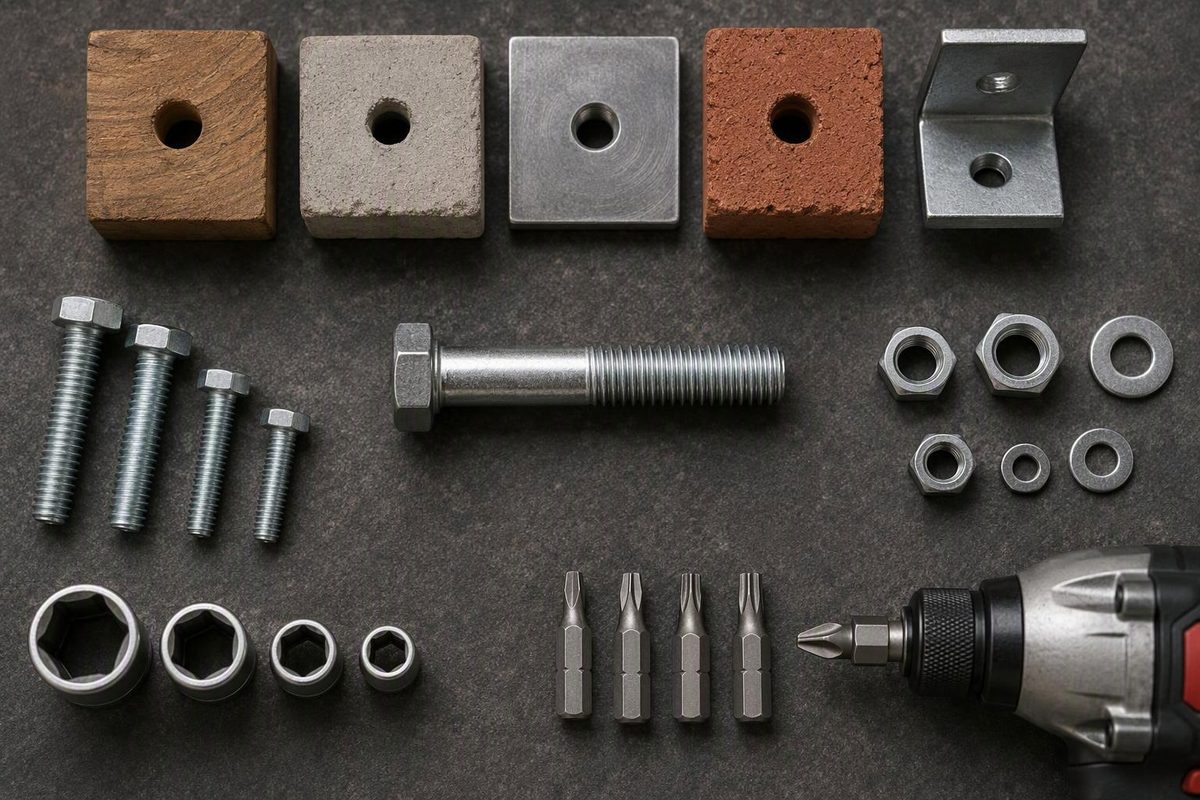
A hex head screw has an external six-sided drive. That head shape does not identify its thread, point, strength or intended material. Before choosing a hole or driver, record these details:
- screw family or product standard;
- nominal thread diameter;
- thread pitch or threads per inch (TPI);
- length measured from beneath the head;
- width across the head’s flats; and
- material, coating and any strength designation.
Do not use the width of the hex head as the screw diameter. They are separate measurements: thread diameter determines the nominal screw size, while width across flats determines the socket or nut-setter size.
First identify the screw family
“Hex head” covers fasteners that make different kinds of connections. The title and scope categories of ASME B18.2.1 distinguish products including hex bolts, hex cap screws, hex flange screws and lag screws rather than treating them as one universal design (ASME B18.2.1).
| What you see | Likely family | What receives the threads | Hole requirement |
|---|---|---|---|
| Blunt or chamfered end; uniform machine thread | Hex cap screw, bolt or hex-head machine screw | Matching nut or tapped hole | Clearance hole in a clamped part, or the specified tap drill for a tapped hole |
| Coarse wood thread; pointed end | Lag screw | Wood | Pilot hole normally required; diameter depends on the screw and wood |
| Sharp point without drill flutes | Tapping screw | Usually sheet metal or another approved base material | Product-specific pilot hole |
| Drill-shaped point | Self-drilling tapping screw | Steel or aluminum within the product’s stated capacity | Drills its own hole in the approved base material |
| Coarse proprietary thread; often an integral washer | Structural wood screw | Wood or engineered wood named by the manufacturer | Follow that product’s instructions or evaluation report |
A self-drilling screw is a subset of self-tapping screws: its integral drill point makes a hole before the threads form mating threads. A conventional tapping screw requires a pilot hole. Material thickness and exposure also affect selection, and an attached component may still require a clearance hole even when the screw drills into the base material (DEWALT Metal Construction Screws Technical Guide).
Measure without mixing dimensions
Use calipers and a thread gauge where possible.
- Diameter: Measure over the outer thread crests, not across the head. Keep the thread system attached to the result:
1/4 in.-20andM6 × 1.0are not alternate names for the same size. - Pitch: For inch threads, record TPI. For metric threads, record crest-to-crest pitch in millimeters.
- Length: For a protruding hex head, measure from the bearing surface beneath the head to the tip. DEWALT specifies this under-head convention for its protruding-head metal-construction screws (technical guide).
- Drive size: Measure between two opposite flats, then select the corresponding six-point socket or nut setter.
- Head and markings: Note any integral flange or washer and record the markings. Markings may identify a grade or property class under an applicable standard, but they do not establish thread size or suitability by themselves.
Do not infer the socket size from nominal thread diameter alone. Identify the governing product standard or measure the actual head.
Match the hole to the thread and material
There is no dependable universal “hex head screw pilot-hole chart.” The head does not determine the hole.
Machine-thread screw used with a nut: Drill a clearance hole appropriate to the nominal thread diameter and required fit. The nut supplies the mating thread.
Machine-thread screw used in a tapped hole: Use the tap manufacturer’s drill chart for the exact diameter and pitch. A clearance-hole value is not a tap-drill value.
Lag screw: Use the screw manufacturer’s table for the screw diameter, wood species and required penetration. A pilot that is too small can split the wood or increase installation torque; one that is too large reduces thread engagement.
Tapping screw: Use the listed pilot diameter and permitted material-thickness range. The pilot must leave enough material for the screw to form or cut its mating thread.
Self-drilling screw: Check the approved base material and thickness range. Do not assume the drill point can penetrate every metal thickness. Also verify whether the attached part needs a clearance hole.
Structural wood screw: Follow the named product’s installation instructions or evaluation report. Predrilling, minimum penetration and permitted materials can differ between products.
Choose the driver and stop at the specified finish
Fit a six-point socket or nut setter fully over the flats. A loose imperial socket on a metric head—or the reverse—can concentrate force at the corners and round the head.
Hold the driver square to the fastener and begin at controlled speed. Stop when the bearing face or integral washer seats as the product instructions require. Head size is not a torque specification, and extra tool power does not justify overdriving.
For structural connectors, a hex head still does not make an ordinary screw acceptable. Use only the fastener type, diameter, length, coating and hole pattern approved for the connector; see why deck screws cannot substitute for joist-hanger fasteners.
A replacement is compatible only when its thread system, dimensions, strength, corrosion protection and application approval all match. The fact that the same socket fits is not enough.