
M4 Screws: Match the Thread, Hole and Driver
How this site is written
Dimensions and compatibility depend on the exact fastener, material, tool, and manufacturer. We show the matching logic and name the source; verify the packaging and tool manual before drilling or driving.
M4 screws have a 4 mm nominal thread diameter. Check the 0.7 mm coarse pitch, length, tap or clearance hole, and head-specific driver before fitting.
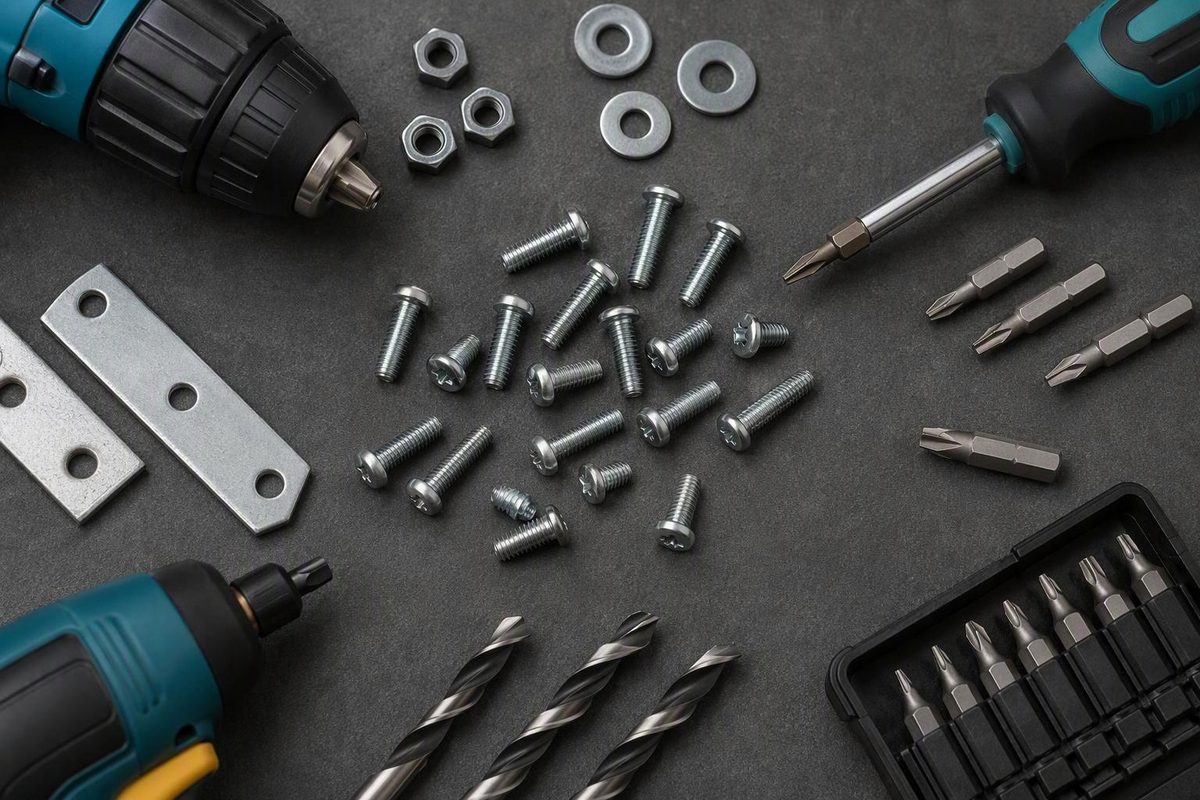
M4 identifies a metric screw thread with a nominal outside diameter of 4 mm. The standard coarse pitch is 0.7 mm. It does not identify the screw’s length, head diameter or driver size. For example, Accu’s M4 socket cap screw lists a 4 mm thread, 0.7 mm pitch and a separate 3 mm hex socket. Source: Accu technical specification.
For a replacement, match the thread diameter and pitch, then check length, head shape, material and strength requirements. A screw that looks similar is not enough.
Read and measure an M4 screw
A full size designation such as M4 × 0.7 × 12 mm means:
| Part of designation | Meaning |
|---|---|
| M4 | Metric thread, 4 mm nominal major diameter |
| 0.7 | Pitch: 0.7 mm between adjacent threads, measured along the screw’s axis |
| 12 mm | Screw length, measured according to head style |
Metric machine-thread sizes are written in diameter–pitch–length order. Listings sometimes omit the pitch when they mean standard coarse thread; confirm the specification rather than relying on that omission. Source: Bolt Depot notation guide.
To identify a loose screw:
- Measure across the outside thread crests, not the thread roots or head. This is the major diameter; M4 is a nominal size, not a promise of an exact 4.000 mm caliper reading.
- Check pitch with a metric thread-pitch gauge. Diameter alone does not establish thread compatibility. Source: Bolt Depot pitch-measuring guide.
- Measure length from beneath the head for ordinary pan, button and socket cap screws. For a flat countersunk head, measure from the top of the head to the tip. Source: Fastener SuperStore measuring guide.
M4 is not a #4 screw. The inch-system #4 diameter is 0.112 in. (about 2.84 mm), not 4 mm. Do not substitute numbered inch screws for metric threads. Source: diameter table. For other designations, see the machine screw sizing guide.
Choose the hole by its job
An ordinary M4 machine screw fits a matching nut or a hole that already has matching internal threads. It is not automatically a self-tapping screw for bare wood, plastic or sheet metal. Source: Bolt Depot fastener type chart.
| Hole’s job | M4 coarse-thread reference | Compatibility limit |
|---|---|---|
| Hole to be threaded with a cutting tap | 3.3 mm drill recommendation | The hole must subsequently be tapped M4 × 0.7; follow the selected tap’s instructions |
| Clearance hole through the attached part | 4.5 mm drill recommendation | Lets the screw pass through to a nut or threaded component; does not provide thread grip |
| Existing threaded hole | Matching M4 × 0.7 internal thread | Check pitch and usable thread depth; do not enlarge it as though it were a clearance hole |
The drill recommendations above come from TR Fastenings’ tapping and clearance chart, which explicitly labels them recommendations. Tap design, material and the assembly drawing can require a different hole size. Forming taps require a larger pre-drilled hole than cutting taps; use the tap manufacturer’s specified diameter. Source: Dormer Pramet pre-drilling guidance. These are not universal wood-screw pilot-hole sizes.
Match the driver to the head—not “M4”
Two M4 screws can need different hex keys:
- An M4 socket cap screw to DIN 912 / ISO 4762 has a 3 mm hex socket in the cited specification.
- An M4 countersunk socket screw to ISO 10642 has a 2.5 mm hex socket in the cited specification.
Phillips, Pozidriv and Torx versions need their own specified bit profile and size. Inspect the recess and product drawing; do not choose a 4 mm driver simply because the thread is M4. See matching a hex driver bit.
Check length and tightening before fitting
For a replacement, check the attached part’s thickness, any washers or spacers, and available thread depth. A longer screw must not bottom out in a blind hole or contact something behind it. Match the original head’s bearing surface or countersunk seat as well as its thread.
Start an ordinary machine screw by hand, keeping it aligned. If it binds before seating, stop and check pitch, alignment, debris and length rather than forcing it with a power tool.
There is no single tightening torque for every M4 screw. Material, strength, head geometry and friction matter; Bossard’s reference guidance accounts for these variables. Use the equipment or joint specification, not a diameter-only torque guess. Source: Bossard preload and tightening guidance.