
Choose the Right Pocket Screw for the Joint
Choose pocket screws by actual stock thickness, wood density, exposure and jig type. See Kreg K4 lengths, head requirements and driving steps.
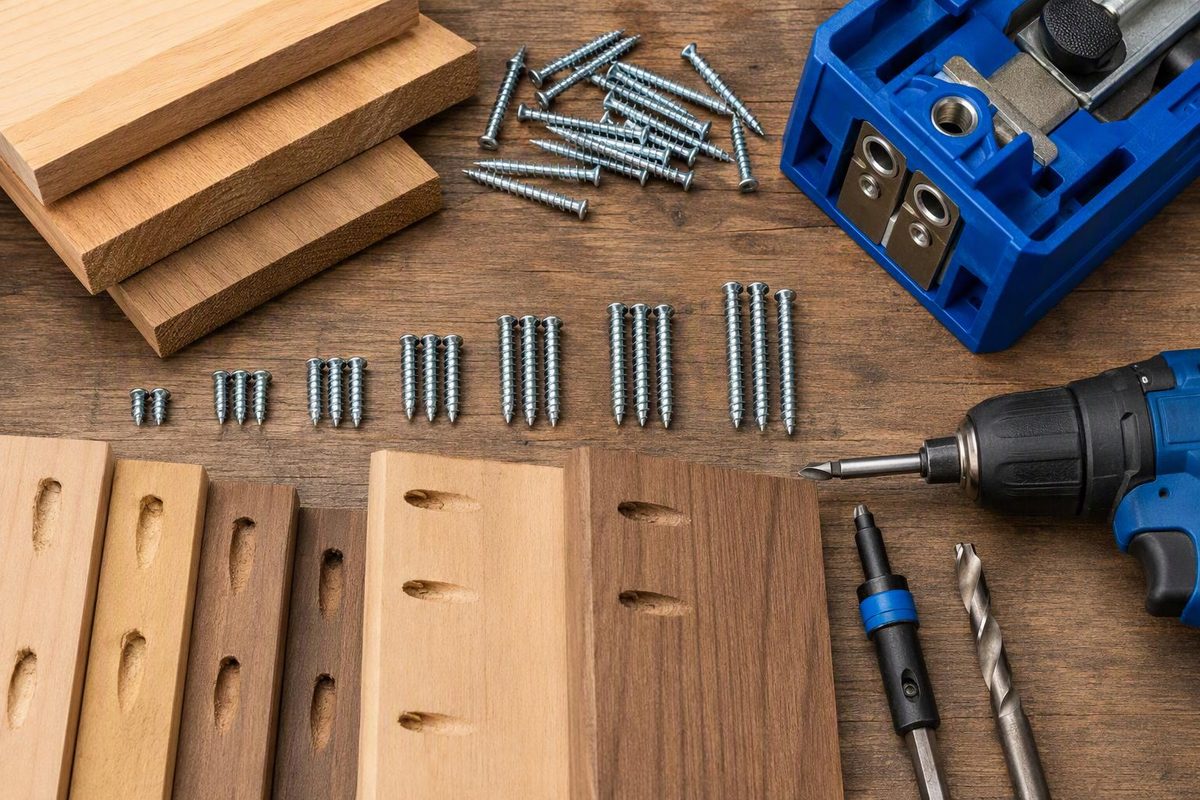
Choose a pocket screw from the actual thickness of the piece drilled for the pocket hole, then match its thread to the receiving material, its finish to the exposure, and its head and driver to the jig system. The screw needs a flat bearing surface under its head so it can seat on the shoulder formed by the stepped bit.
For the Kreg K4 standard drill guide, common combinations are 1 in. screws for 1/2–5/8 in. stock, 1 1/4 in. screws for 3/4 in. stock and 2 1/2 in. screws for 1 1/2 in. stock. These settings are specific to the K4 standard guide, not universal settings for Micro, XL or other pocket-hole systems.
Select the drilled piece’s thickness, receiving material and exposure to see the K4 match.
K4 Standard Pocket-Screw Match
Applies to the Kreg K4 standard drill guide. Measure the piece that will contain the pocket hole.
- Thread
- Coarse (#8 in Kreg’s standard line)
- Head
- Maxi-Loc flat-underside head
- Finish
- Zinc for dry indoor use
View the source chart and fallback rules
| Stock | K4 screw |
|---|---|
| 1/2 in. | 1 in.* |
| 5/8 in. | 1 in. |
| 3/4 in. | 1 1/4 in. |
| 7/8–1 1/8 in. | 1 1/2 in. |
| 1 1/4–1 3/8 in. | 2 in. |
| 1 1/2 in. | 2 1/2 in. |
- *The K4 manual recommends a pan-head screw for 1/2 in. material.
- Use coarse threads for softwood and sheet goods; use fine threads for dense hardwood.
- Kreg recommends zinc for dry indoor use, Blue-Kote for damp, wet or treated lumber, and stainless for highly corrosive environments.
Source: 2018 Kreg K4 owner’s manual for standard-guide lengths; Kreg selection guidance for thread, head and finish. Micro and XL settings differ.
Identify a Compatible Pocket Screw
| Feature | What to match | Why it matters |
|---|---|---|
| Head | Flat bearing underside; washer-style, Maxi-Loc or specified pan head | Seats on the pocket’s flat shoulder instead of wedging it apart |
| Length | Measured from under the head to the tip | Controls penetration into the mating piece |
| Thread | Coarse for softwood and sheet goods; fine for dense hardwood | Matches thread bite to the receiving material |
| Drive | Exact recess and size—#2 square for Kreg K4 screws | Poor fit can cam out and damage the recess |
| Finish or material | Indoor zinc, compatible exterior coating or stainless, as specified | Moisture and treated lumber can make an otherwise suitable screw unsuitable |
| System | Standard, Micro or XL | Bits, holes, heads and screws are not automatically interchangeable |
Do not substitute a conventional flat-head wood screw or drywall screw merely because its length looks right. A conventional screw’s conical underside bears like a wedge in the pocket. Kreg explains that its pocket screws instead have a flat underside. It also distinguishes the broad Maxi-Loc head used for most work from a smaller pan head for dense hardwood, 1/2 in. stock and confined hole spacing (Kreg head and thread guidance).
Kreg K4 Standard Screw-Length Chart
This table comes from the 2018 Kreg K4 manual and applies to that jig’s standard guide geometry. Screw length is measured from under the head to the tip (Kreg K4 owner’s manual).
| Actual thickness of drilled piece | Standard screw length |
|---|---|
| 1/2 in. (13 mm) | 1 in. (25 mm)* |
| 5/8 in. (16 mm) | 1 in. (25 mm) |
| 3/4 in. (19 mm) | 1 1/4 in. (32 mm) |
| 7/8–1 1/8 in. (22–29 mm) | 1 1/2 in. (38 mm) |
| 1 1/4–1 3/8 in. (32–35 mm) | 2 in. (51 mm) |
| 1 1/2 in. (38 mm) | 2 1/2 in. (64 mm) |
*The K4 manual recommends a pan-head pocket screw for 1/2 in. material. With its optional Micro-Pocket guide, it specifies a 3/4 in. screw instead. Follow the manual for the guide actually installed.
Measure the board rather than relying on its nominal label: a “1×” or “2×” name is not the finished thickness. If the joint members differ in thickness, use the drilled piece to set the K4 jig and select from this table. Also confirm that the mating piece is thick enough to contain the angled screw tip.
Test the complete setup on representative offcuts when either piece is thin, the hole is near an edge or the parts have unequal thicknesses.
Match the Thread to the Receiving Material
Use coarse threads in pine, cedar, fir, plywood, MDF and similar soft or composite materials. Use fine threads in dense hardwoods such as oak, maple, cherry and walnut.
The K4 manual identifies Kreg’s standard fine screw as #7 and its coarse screw as #8. Those are manufacturer-specific combinations of diameter, thread and head—not permission to substitute any #7 or #8 screw (Kreg K4 manual).
Thread selection concerns the material receiving the threads. When joining dissimilar woods, do not choose solely from the species of the piece containing the pocket hole.
Match the Finish to Moisture and Treatment
For Kreg’s current product families, the company recommends zinc screws for indoor work where moisture is not a concern, Blue-Kote screws for damp or wet work and treated lumber, and stainless screws for highly corrosive environments (Kreg screw-selection guide, updated June 2026).
These recommendations do not establish that another maker’s coating is equivalent. Verify the selected screw’s compatibility with the wood treatment, environment and any dissimilar metal it will contact.
Use the Jig’s Stepped Bit and Stop Collar
A pocket-hole jig uses a stepped bit to drill a pilot hole and clearance hole while forming the bearing shoulder for the screw head. Set both the jig and the bit’s stop collar for the measured stock thickness. The collar limits drilling depth; on the K4, drilling stops when the collar meets the guide (Kreg K4 owner’s manual).
Kreg pocket screws have a self-tapping point intended to enter the mating workpiece without a separate pilot hole (Kreg pocket-screw design explanation). That does not make an ordinary twist drill interchangeable with the jig’s stepped bit.
Standard, Micro and XL guides use system-specific components. A nearby nominal diameter in a drill-bit chart does not prove compatibility.
Drill and Drive the Joint Without Over-Tightening
- Measure actual thickness. Check more than one point if plywood or dressed lumber varies.
- Set the guide and stop collar. Tighten the collar securely. Clamp the workpiece and, when the guide is used outside its base, clamp the guide rather than holding it by hand.
- Drill as the jig manual directs. For the K4, Kreg specifies full drill speed. Clear chips by partially withdrawing the bit, and stop when the collar reaches the guide.
- Clamp both joint members. The screw tip can shift an unclamped joint as it enters the mating piece.
- Fit the specified driver. The K4 uses a long #2 square-drive bit. Inspect other screw systems rather than assuming the same recess. See how to match a driver-bit tip and size.
- Drive with a drill/driver and low clutch setting. Stop when the head is snug against the shoulder. Kreg says over-driving commonly occurs with an impact driver or a drill clutch set too high and recommends a standard drill with a low initial clutch setting (Kreg pocket-hole guidance).
If the tip emerges through the face, stop and check the screw length, jig setting, collar position and mating-piece thickness. Do not continue driving.
If the screw spins without tightening, its threads have probably stripped the receiving fibers. Increasing the clutch setting will remove more material rather than restore the joint.
If the pocket splits at the head, check for a conical substitute screw, an incompatible head or guide, and over-driving.
General Charts Do Not Approve Structural Connections
Pocket screws suit many cabinetry, face-frame, furniture and shop joints, but a general length chart is not engineering approval for structural framing, stairs, guards, lifting points or metal connectors. For a safety-critical or code-governed connection, use the specified joint detail and approved fastener schedule.