
Choose Screws for Metal by Where the Threads Will Hold
How this site is written
Dimensions and compatibility depend on the exact fastener, material, tool, and manufacturer. We show the matching logic and name the source; verify the packaging and tool manual before drilling or driving.
Choose machine, self-tapping or self-drilling screws for metal by hole type, substrate, thickness, access and exposure—not head style alone.
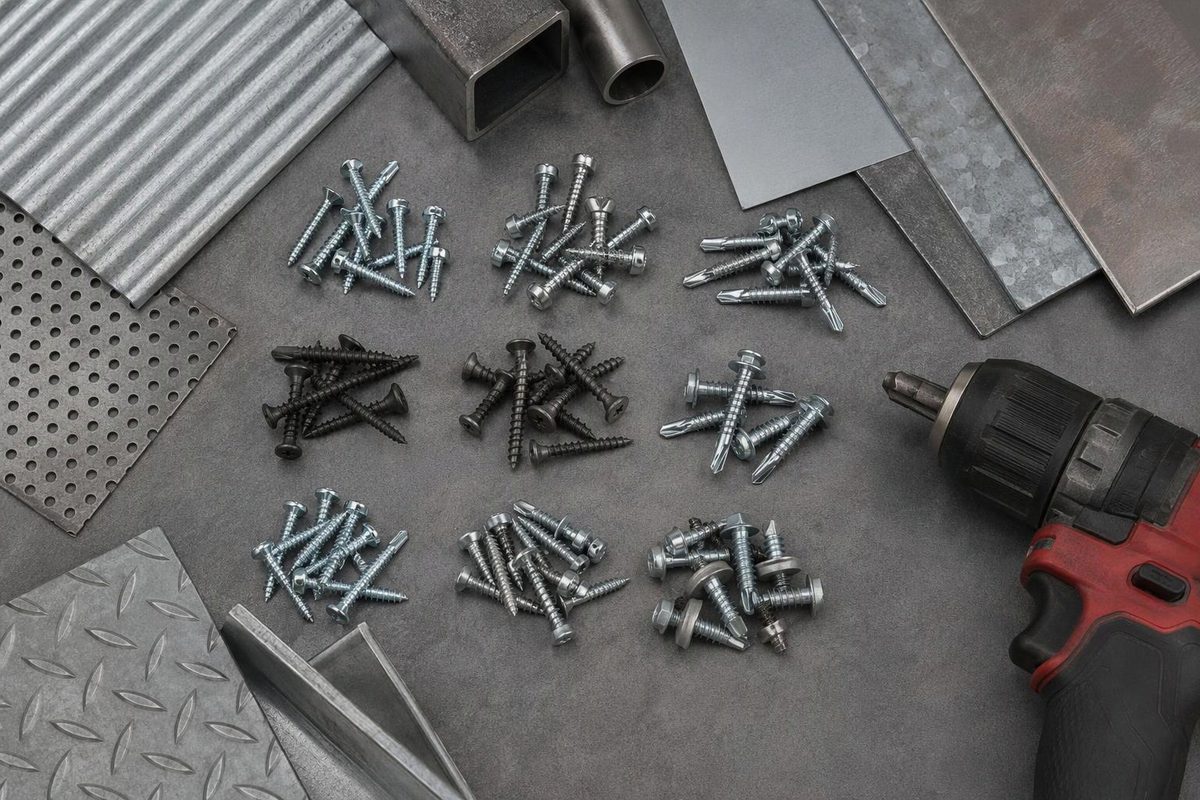
Choose screws for metal by where the threads will hold: use an ordinary machine screw with a matching nut or tapped hole; a non-drilling self-tapping screw in a correctly sized pilot hole; or a self-drilling screw rated to drill and tap the particular metal thickness. These are different connection methods, not interchangeable versions of the same screw. Bolt Depot’s type chart and DeWalt’s 2024 metal construction screw guide distinguish them.
Before choosing a diameter or length, identify the attachment material—the piece under the head—and the base material, where a tapping screw’s threads grip. A metal bracket fastened to wood needs a different screw from the same bracket fastened to steel. With a machine screw, identify the mating nut or threaded hole instead.
Choose the connection first
| What you are joining | Starting choice | Compatibility limit |
|---|---|---|
| A part to an existing threaded metal hole | Machine screw | Match the thread system, diameter and pitch; verify usable hole depth. |
| Two parts with access to fit a nut behind them | Machine screw or bolt with matching nut | Use clearance holes through the parts; select the fastener grade and length for the connection. |
| Sheet metal with an unthreaded hole that can be prepared | Non-drilling self-tapping screw | Use the pilot-hole specification for that screw and base metal. A sharp point alone does not establish drilling ability. |
| Metal-to-metal fastening without a separate drilling operation | Self-drilling screw | The exact product must cover the material, drilling thickness and total assembly thickness. |
| A removable fitting on thin sheet or hollow tubing, with only front access | Machine screw into a suitable rivet nut | Check the insert’s material, hole preparation, grip range, load rating and installation tool. |
The machine, sheet-metal and drill-point distinctions come from Bolt Depot. For the last option, PennEngineering explains how rivet nuts provide permanent threads with one-sided installation access, including tubing and serviceable assemblies.
Self-drilling screws are also self-tapping: they make both the hole and the threads. Here, “non-drilling self-tapping” means a tapping screw that requires a prepared hole in metal. DeWalt’s guide identifies thread-forming and thread-cutting tapping screws, with self-drilling tapping screws as a subset—not a competing thread category. Source: DeWalt.
For replacement screws in existing threads, use the machine screw sizing guide rather than choosing a pointed screw that merely looks similar.
Match the substrate and thickness
Record each layer’s thickness in millimetres or inches, plus any gap between layers. Do not rely on “thin metal” or a gauge number alone when comparing a product’s capacity.
For self-drilling screws, check two separate limits:
- Drilling capacity: what the point can penetrate. The unthreaded drill section must pass through the material before the threads engage; otherwise the screw can bind and break.
- Grip or load-bearing length: how much assembly thickness the screw can fasten. Nominal screw length is not all usable grip. DeWalt excludes at least the drill point and first three full threads from self-drilling load-bearing length.
These limits are explained in Simpson Strong-Tie’s self-drilling guidance and DeWalt’s guide. Use the exact product chart, not a universal capacity inferred from the point number. The self-drilling screw guide covers point, grip and driver selection in more detail.
For screws that drill or form threads, steel and aluminum need explicit product compatibility. DeWalt’s selection chart separates fastener families by substrate and warns that thickness and exposure can change the choice. A screw approved for drilling steel is not automatically suitable for aluminum—or for drilling stainless steel. If the manufacturer does not list your base metal, do not assume compatibility. Source: DeWalt.
For metal attached to wood, select for the wood base. DeWalt lists dedicated metal-panel-to-wood fasteners. Conversely, wood attached to steel may need a winged self-drilling screw: the wings create clearance through the wood to prevent it lifting away from the steel as the screw advances. Source: DeWalt.
Match the hole, head and exposure
A clearance hole lets the screw pass through; a tapped hole already has mating threads; a pilot hole lets a tapping screw create its threads. Do not substitute one hole specification for another. For tapping screws, obtain the manufacturer’s hole recommendation before selecting the drill bit—not a wood-screw pilot chart. See the self-tapping stainless-steel guide for the more specific selection checks.
Choose the head for its seating surface. A flat head needs a compatible countersunk seat; a hex washer head provides a built-in bearing surface. Neither shape tells you whether the screw is machine-threaded, self-tapping or self-drilling. Source: Bolt Depot.
For outdoor or wet connections, check both corrosion resistance and compatibility between the fastener and joined metals. Dissimilar metals in contact with a conductive liquid can suffer galvanic corrosion. “Stainless” is therefore not a complete specification for an aluminum assembly; obtain the manufacturer’s material, coating and isolation guidance for the exposure. Source: DeWalt.
Verify installation before driving
Match the bit or nut setter to the exact drive size, then follow the screw’s current speed and tightening instructions. For self-drilling screws, more speed and torque are not automatically better: DeWalt advises against impact-driver installation, and Simpson recommends a drill motor rather than an impact driver or hammer drill to reduce point wear. DeWalt guidance; Simpson guidance.
For load-bearing construction, use a documented connection design and rated fastener—not a generic box labelled “metal screws.” DeWalt’s guide places responsibility for verifying connection suitability, loads and applicable requirements with the responsible design professional.