
Match the stainless grade, point, pilot hole and driver
Choose 18-8, 304, 316, 410 or bi-metal self-tapping screws by exposure, sheet thickness, pilot-hole data and driver requirements.
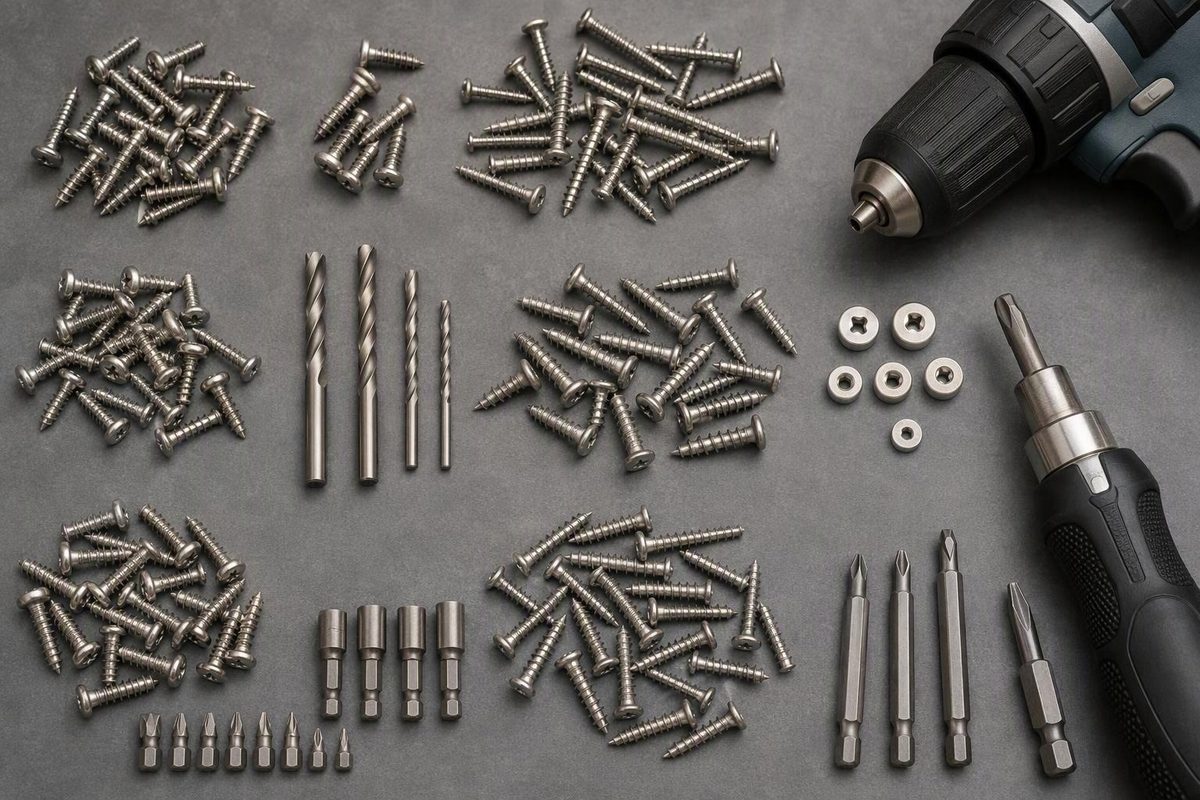
A stainless self-tapping screw forms or cuts its own mating thread. It does not necessarily drill its own starting hole. If the point resembles a small twist drill, it is self-drilling as well as self-tapping; a sharp or blunt tapping point may still require a pilot hole.
Before buying, identify the complete fastener—not merely “stainless self tapping”:
Example: #10-16 × 1 in, Type AB, 18-8 stainless, hex washer head, 5/16 in AF drive
That description gives the nominal diameter, 16 threads per inch (TPI), length, point/thread form, material, head and driver size. For a self-drilling screw, also record its point number and published drilling capacity.
Choose the stainless grade before the point
| Marking or description | Practical selection limit |
|---|---|
| 18-8, 302HQ, 304 or A2 | General indoor and exterior service where severe chloride exposure is not expected. “18-8” is a family description, not a complete performance specification. A2 fasteners may be made from 302HQ or 304. |
| 316 or A4 | Prefer for more aggressive chloride exposure, subject to the project specification. Grade 316 resists chloride pitting better than 304, but it is not corrosion-proof. |
| 410 | Heat-treatable and hard enough for one-piece drill points, but less corrosion-resistant than 300-series stainless. Use only where the product’s exposure limits are acceptable. |
| Bi-metal | Typically a 300-series stainless head and shank fused to a hardened carbon-steel drill point and tapping threads. The product’s coating, substrate and exposure approval still control. |
Atlas identifies 302HQ as a standard material for self-tapping screws, 316 as having improved chloride-pitting resistance and 410 as a martensitic grade for hardened applications (World Stainless grade datasheets). ASSDA maps the common fastener designations 304/A2, 316/A4 and hardened 410/C1 (ASSDA fastener guide).
Do not assume every stainless screw can drill steel. Simpson Strong-Tie uses heat-treated 410 stainless for one drill-point siding screw and states that 410 offers less corrosion resistance than Type 305 or 316 (Simpson Strong-Tie DPSD specifications). Evaluated bi-metal screws take another route: their head and shank are 300-series stainless, while their fused drill point and tapping threads are hardened carbon steel (ICC-ES ESR-4374).
Match the point to the hole
- Type A or AB sharp point: may pierce some thin materials, but “self-tapping” alone does not guarantee installation without a pilot hole.
- Type B blunt point: requires a prepared hole.
- Thread-cutting point: removes material while creating the mating thread.
- Thread-forming point: displaces material without producing chips.
- Drill point: drills and taps in one operation, but only within that fastener’s published material and thickness range.
These distinctions are explained in SFS’s self-tapping screw guide, which also directs users to product data for pilot-hole sizes because substrate thickness affects the requirement.
Drilling capacity is product-specific. One 5.5 mm A4 EJOT screw has a hardened drill point, published drilling capacities of 1.0 + 5.0 mm or 2.0 + 4.0 mm for its specified assemblies, and a maximum installation speed of 1,300 rpm (EJOT JT6-6-5.5 data). Those limits do not transfer to another 5.5 mm screw.
Type AB reference drill sizes—not stainless approvals
TR Fastenings publishes these inch-series values for case-hardened steel Type AB screws in a simple fastening joint. It requires prior testing for other screw or sheet materials, so use a stainless screw manufacturer’s table when selecting the actual hole (TR Fastenings hole-size table).
| Type AB size | TPI | Reference drill | Drill diameter |
|---|---|---|---|
| #6 | 20 | #32 | 0.1160 in |
| #8 | 18 | #29 | 0.1360 in |
| #10 | 16 | #21 | 0.1590 in |
| #12 | 14 | #14 | 0.1820 in |
| 1/4 | 14 | #4 | 0.2090 in |
Sheet thickness, sheet strength, screw hardness and whether the hole is drilled or punched can change the required diameter. For number, letter and fractional bit conversions, use the drill-bit sizes chart.
A hole that is too small raises driving torque and can break the screw. A hole that is too large reduces thread engagement and pull-out resistance. Test representative material when the fastener manufacturer requires it.
Set up the driver and install
- Check drilling capacity, grip and length separately. Compare the published drilling capacity with the metal layers the point must penetrate. Then verify that the selected length accommodates the complete clamped stack, any gap, and the required protrusion or embedment.
- Drill the specified pilot where required. Deburr without enlarging the hole beyond its permitted range. Do not substitute a clearance-hole size.
- Fit the exact driver. Match the Phillips, square, Torx or hex size. “Hex head” alone does not identify the across-flats dimension; see the hex-head screw guide.
- Use a drill/driver or screw gun at the published speed. Keep the screw perpendicular. Product limits vary: the EJOT example specifies 1,300 rpm maximum, while ICC-ES ESR-4374 permits 1,800 or 2,500 rpm for particular evaluated screws. None is a generic setting.
- Slow down as the head seats. A torque-limiting clutch or depth-sensitive nose can help prevent stripped sheet threads and crushed sealing washers. Stop when the joint is clamped as the product instructions require; do not continue applying torque after seating.
For roofing or cladding, treat the sealing washer and its material as part of the specified assembly. For a structural connection, use only the specified fastener and published spacing and load data. A same-size general-purpose stainless self-tapper is not an automatic substitute.
Diagnose the mismatch before trying another screw
| Symptom | Likely mismatch | Correction |
|---|---|---|
| Point spins or discolors | Point is outside its drilling capacity, speed or pressure is wrong, or point is dull | Stop; confirm substrate grade and thickness, then use the specified point and speed or predrill if permitted. |
| Screw snaps while tapping | Pilot is too small, fastener is unsuitable for the substrate, or driving torque is excessive | Verify the manufacturer’s hole table and fastener material; use the specified installation tool and setting. |
| Screw turns without clamping | Pilot is too large, sheet has stripped, or thread engagement is insufficient | Do not keep driving. Use the approved repair fastener or repair method. |
| Head or recess strips | Driver is wrong or worn, tool is tilted, or final speed is excessive | Replace the bit, hold the tool square and finish at lower speed. |
| Rust appears early | Grade, coating or dissimilar-metal interface does not suit the exposure | Recheck the complete material system rather than assuming all stainless grades are equivalent. |