
Allen Key Drill Bit: Match the Hex Tip, Shank and Tool
How this site is written
Dimensions and compatibility depend on the exact fastener, material, tool, and manufacturer. We show the matching logic and name the source; verify the packaging and tool manual before drilling or driving.
Choose a hex driver bit by exact metric or inch tip size, shank fit and tool rating. Use a drill without confusing drive size with screw size.
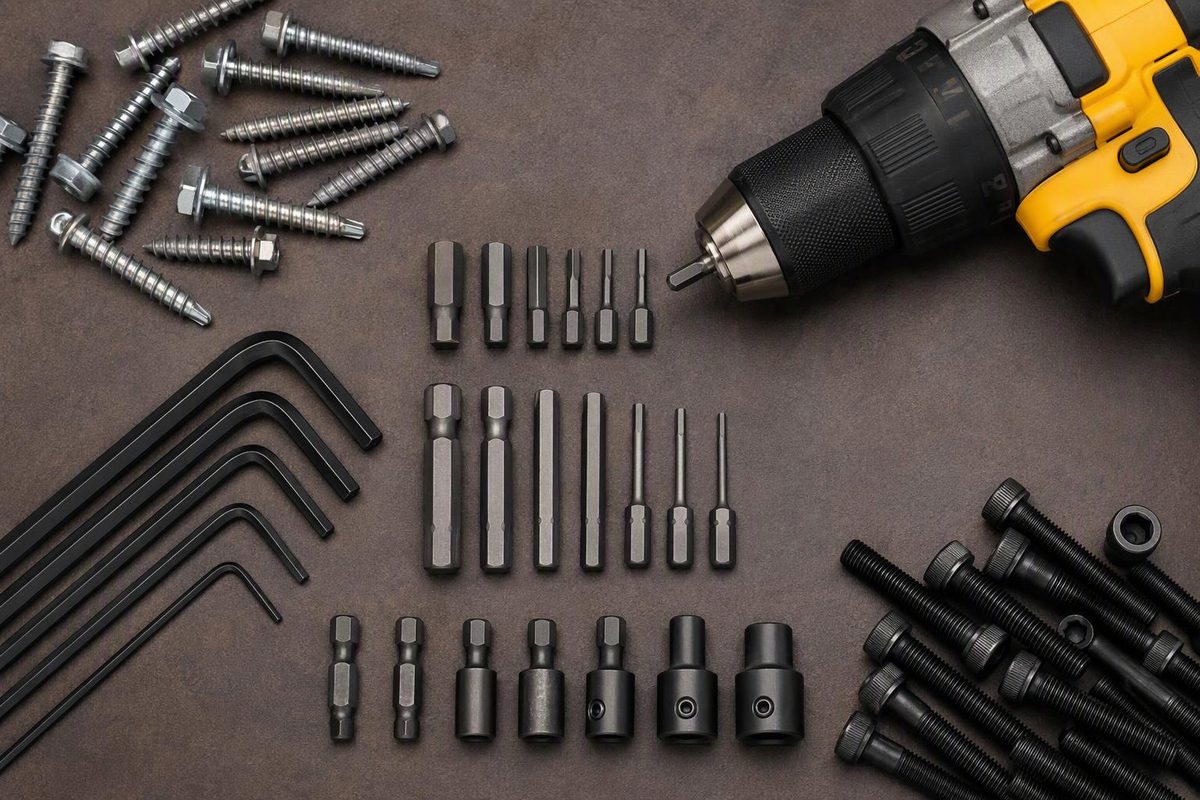
An Allen key drill bit is a hex driver bit for turning screws with an internal six-sided recess. It drives a fastener; it does not drill a hole. Choose the exact metric or inch tip size, then check the shank fits your drill or bit holder. For example, Wera’s 840/4 Z range has a 1/4-inch hex shank but offers many different metric and inch tips. The shank size is not the screw’s drive size. Wera bit specifications
A drill/driver can turn these screws with a suitable bit, provided the assembly instructions permit powered installation. Start with low speed and a low clutch setting—not full-power drilling mode. Drill clutch guidance
Match the recess before buying
Identify the drive inside the screw head. An internal hex recess needs a hex driver bit. An external hex head needs a socket or nut setter; a six-lobed star recess needs a matching Torx bit.
| Detail to identify | What to choose or check |
|---|---|
| Hex recess size | Exact tip size in mm or inches, measured across opposite flats—not corner to corner |
| Screw thread designation | Do not use an M-size or screw diameter as the bit size; consult the fastener drawing or assembly instructions |
| Tool connection | Shank and holder geometry compatible with the drill chuck or driver collet |
| Access | Enough usable reach for the tip to seat fully without the holder hitting the work |
| Tool type | A bit and holder approved for the tool, including impact use if applicable |
If the instructions identify a 4 mm Allen key, choose a 4 mm hex driver bit. Do not substitute a nearby inch size because it enters the recess: 5/32 inch = 3.96875 mm, not 4 mm. A dimensional near-match is not a compatibility recommendation.
For an unidentified screw, clean the recess and try known-size, unworn keys or bits by hand. The correct tip should seat fully and fit snugly; do not force a larger tip or power a loose one. Bondhus describes a snug tool-to-fastener fit as important for minimizing slippage and stripping. Bondhus power-bit guidance
Straight tip, ball end or impact-rated?
Use a straight hex tip as the default for accessible screws. Keep it aligned with the screw axis and fully engaged.
A ball-end bit is an access option when straight alignment is obstructed. Bondhus says its ball-end power bits can insert into a screw at a 25° angle. That is a product-specific access specification, not a universal limit or a torque rating. Follow the selected bit’s instructions rather than assuming angled driving is suitable for final tightening. Bondhus ball-end specifications
For an impact driver, check explicit impact suitability for both the bit and holder. A 1/4-inch hex shank alone does not establish that rating. Wera, for example, specifically identifies its Impaktor hex bits for impact screwdrivers. Impact suitability does not establish that the screw or assembly can tolerate impact tightening. See the separate guide to driver-bit and impact-driver compatibility. Wera Impaktor specifications
Use the drill without rounding the recess
- Disconnect power before changing accessories: remove the battery or unplug the tool. Secure the workpiece and wear eye protection.
- For a screw entering a nut or tapped hole, start it by hand before using power. Do not use the drill to pull misaligned threaded parts together.
- Select screwdriving mode and low gear, where available. Start with a low clutch setting and light trigger pressure.
- Seat the stationary bit fully, then turn slowly. Stop if the bit slips or the screw binds; inspect fit and alignment before increasing torque.
- Finish to the assembly’s requirement. For delicate hardware, stop powered driving before final seating and finish by hand. Where a torque value is specified, use an appropriate torque tool rather than guessing a clutch number.
Bosch’s GSR/GSB 120-LI manual distinguishes screwdriving from drilling and impact-drilling modes, specifies low gear for screwdriving, and warns that rotating bits can slip when applied to a screw. Check your own drill’s controls and instructions. Bosch operating manual, pages 6–9
Works when: the exact tip seats fully, the tool connection is compatible, and speed and tightening follow the assembly instructions.
Fails when: a near-size tip is loose, the holder prevents full engagement, or more power is used to overcome binding or slipping.