
Torx Bit: Match the Drive Profile, Size and Tool
Identify a Torx bit by profile and T-size, compare typical tip dimensions, and distinguish standard, security and Torx Plus before driving.
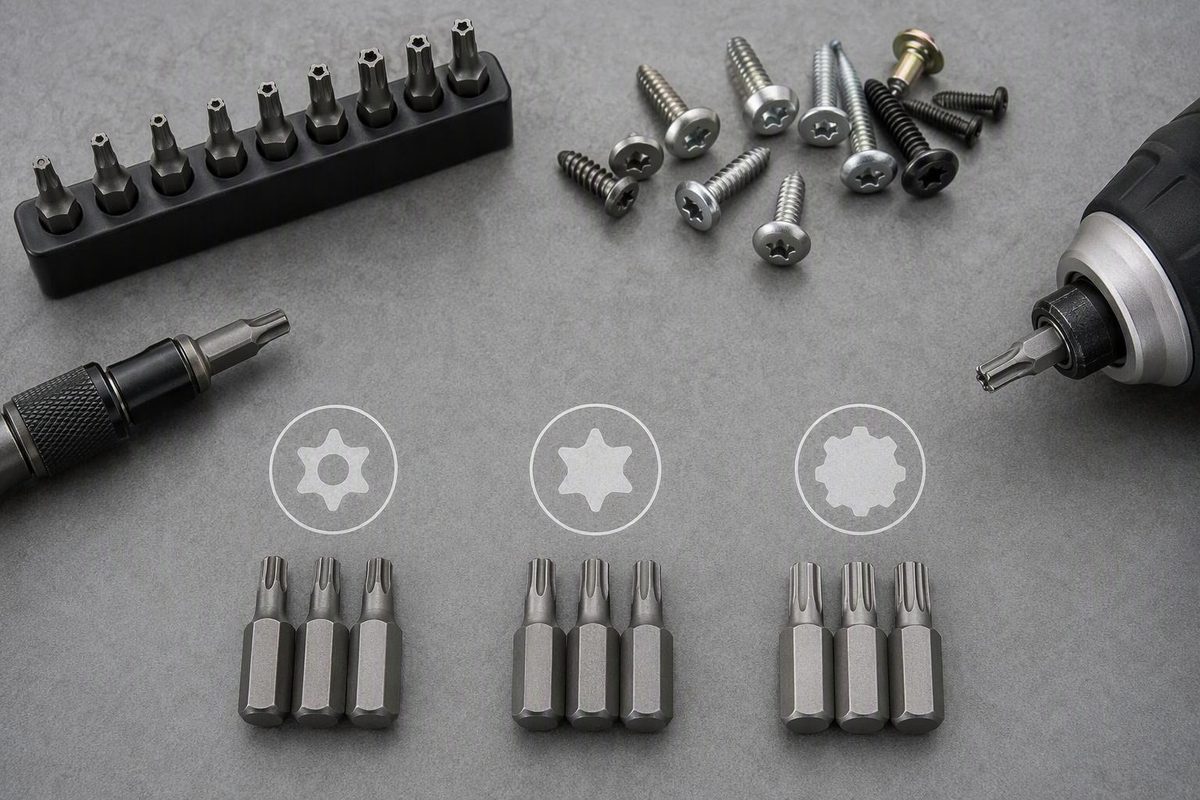
Choose a Torx bit that matches both the screw’s drive profile and its exact T-size. T25 is a size designation—not a 25 mm tip, screw diameter or pilot-hole size. Check the screw packaging or equipment service instructions first; use a hand fit-check to confirm the match before applying power.
A Torx bit engages an internal six-lobe recess. The same Torx drive sizes serve both inch- and metric-threaded screws, so you do not need separate “SAE” and “metric” Torx sets. The thread system still matters when replacing the screw. Acument’s Torx reference distinguishes the internal drive from external Torx heads, which require sockets.
Identify the profile before the size
| Screw-head feature | Tool to select | Compatibility limit |
|---|---|---|
| Standard internal Torx recess | Standard Torx bit of the specified T-size | A nearby size is not a substitute |
| Internal Torx recess with a center pin | Security/tamper-resistant Torx bit with a center hole | A solid-tip bit cannot seat over the pin |
| Internal Torx Plus recess | Matching Torx Plus bit, often marked IP | Treat it as a distinct profile, not simply another name for Torx |
| Five-lobe Torx Plus tamper-resistant recess with a center post | Matching tamper-resistant Torx Plus tool | A six-lobe security Torx bit is the wrong profile |
| External Torx head | Matching external Torx socket | An internal Torx bit is the wrong tool type; distinguish Torx from Torx Plus |
The center-hole requirement is documented in Wera’s Torx BO bit range. Count the lobes as well as checking for a pin: Acument identifies tamper-resistant Torx Plus as a five-lobe design.
Torx and Torx Plus are not fully interchangeable. Acument permits standard Torx tools to remove and reinstall internal Torx Plus fasteners in service conditions. That limited allowance is not a reason to buy the wrong profile for routine installation. It also does not apply to external Torx Plus: Acument specifies Torx Plus sockets and says standard Torx sockets are incompatible. Torx Plus compatibility reference.
Torx bit size lookup
These are selected typical tool-tip point-to-point dimensions, reproduced from Wiha’s Torx tool chart. They are identification references, not screw-recess tolerances or pilot-hole recommendations.
| Torx size | Typical tip point-to-point dimension |
|---|---|
| T8 | 2.31 mm |
| T10 | 2.74 mm |
| T15 | 3.27 mm |
| T20 | 3.86 mm |
| T25 | 4.43 mm |
| T27 | 4.99 mm |
| T30 | 5.52 mm |
| T40 | 6.65 mm |
Do not choose the bit from screw diameter alone. Head style can change the required drive size: for example, Wiha’s chart lists a #8 Torx socket-cap screw as T25 but a #8 Torx flat-head screw as T15. Use the actual fastener specification rather than treating that chart as universal. Wiha screw-to-drive chart.
Confirm fit, then match the driving tool
Check fit with a loose bit or hand driver before fitting it to a powered tool:
- Inspect the recess. Remove loose debris that prevents seating, and check for damaged lobes or a center pin.
- Insert the specified bit by hand. It should seat fully without force and without excessive rotational play. Do not hammer in a larger bit or keep using a smaller one because it catches.
- Check access. The bit must reach the recess without the holder or tool nose obstructing engagement. Keep it aligned with the screw axis.
- Check the tool end separately. T25 describes the tip; it does not establish shank size, retention geometry or impact suitability.
For an impact driver, choose a bit explicitly rated for impact use and a compatible shank or holder. Wiha, for example, identifies its MaxxTor bits as impact-rated with a 1/4-inch hex drive; neither feature follows merely from the word “Torx.” Manufacturer specifications. See driver-bit shanks and holders for the tool-side match.
Works when: the profile and size match, the bit seats fully, and the fastener’s installation instructions permit the selected tool.
Fails when: the tip is worn, partly seated, undersized or the wrong profile. If it slips or damages the recess, stop and recheck rather than increasing power. A correct Torx bit does not set the tightening torque or make the fastener suitable for the substrate and load; follow the fastener or equipment instructions for those limits.