
Use Only Fasteners Approved for the Exact Hanger
Ordinary deck screws do not replace joist-hanger fasteners. Learn how to verify approved nails or connector screws, patterns, loads, and coatings.
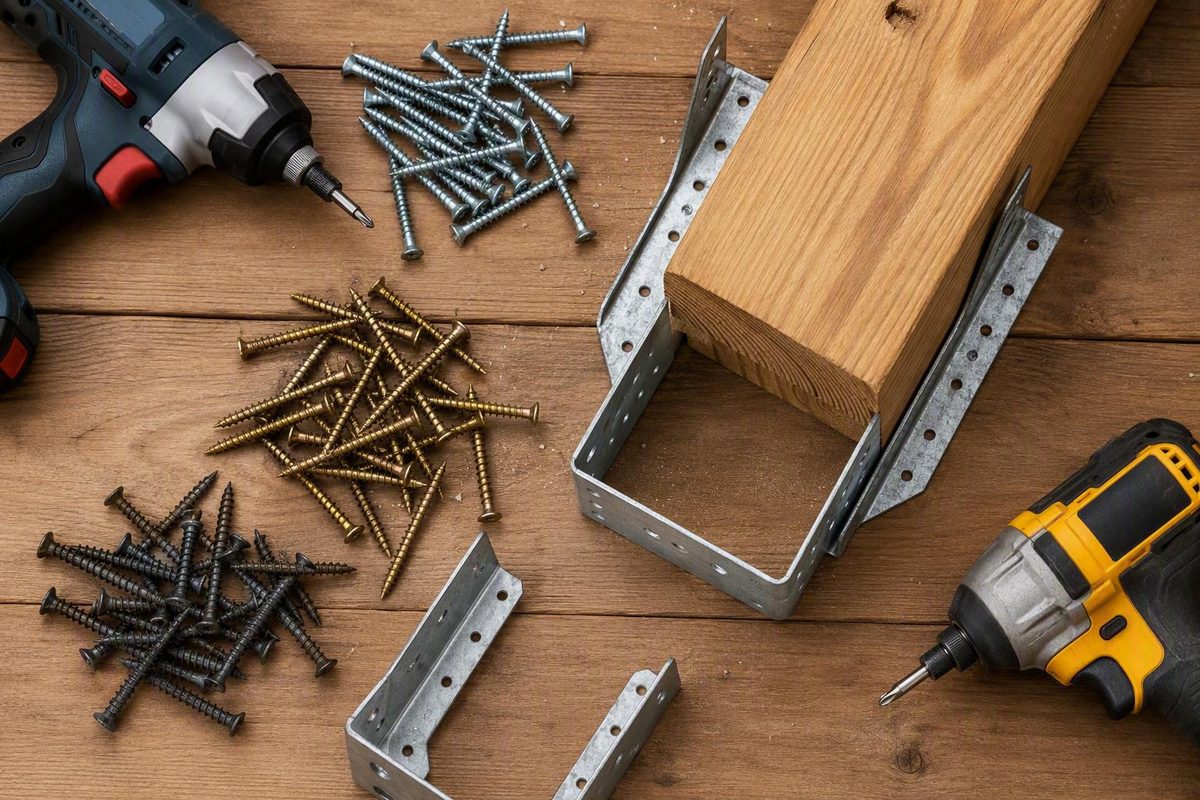
Ordinary deck screws generally cannot be used in joist hangers. Use the nails or structural connector screws expressly approved for the exact hanger model, hole location, quantity, and installation schedule. A screw is not acceptable merely because it is galvanized, exterior-rated, structurally marketed, or similar in size.
This is not a blanket prohibition on screws. Purpose-built structural connector screws are permitted in some hangers, but approval applies to the named screw and connector configuration. The controlling distinction is specified fastener versus unapproved substitution, not simply nail versus screw.
Simpson Strong-Tie warned on August 25, 2026, about increased substitution of unapproved fasteners in connectors. The company says its published connector performance depends on the specified fasteners and does not guarantee performance with unapproved alternatives (Simpson Strong-Tie warning on unapproved fasteners).
Choose the connector, candidate fastener, and documentation status; the tool will show whether the installation can proceed.
This picker does not invent a universal size or count. It shows whether your documentation is complete enough to use the candidate fastener and identifies the remaining checks.
No universal fastener size or count applies. Some listed Simpson LUS configurations combine 1½-inch and 2½-inch #9 SD Connector screws, with quantities varying by model. These dimensions are examples of model-specific variation, not a schedule for an unidentified hanger.
Connector And Fastener Reference
| Connector | Ordinary Deck Screw | Approved Nail Basis | Approved Screw Basis | Universal Size And Count |
|---|---|---|---|---|
| Joist hanger | No, unless the exact product is expressly listed | Exact hanger schedule: diameter, length, finish, quantity, and hole location | Named connector screw, exact model, length, count, pattern, and load notes | — Model-specific |
| Hurricane tie | No, unless the exact product is expressly listed | Exact tie schedule: product dimensions, quantity, connected members, and holes | Only where documentation names the screw and complete installation | — Model-specific |
| Post base | No, unless the exact product is expressly listed | Exact post-base schedule and connection configuration | Only where the exact base documentation permits it | — Model-specific |
Candidate Fastener Reference
| Candidate | Default Decision | Evidence Required | Capacity Treatment |
|---|---|---|---|
| Ordinary deck screw | Reject as an assumed substitute | Express listing of that exact product for the exact connector and pattern | No conversion from similar length, gauge, or coating |
| Generic “structural” screw | Label alone is insufficient | Connector documentation naming the exact screw | Evaluation for other structural uses does not approve every connector |
| Specified connector nail | Use only as scheduled | Diameter, length, material, finish, quantity, penetration, and location | Published load applies only to the documented assembly |
| Named connector screw | Use only in listed configurations | Product designation, gauge, length, count, model, pattern, and finish | May have a different allowable load; one published example uses a 0.83 factor for specified #9 substitutions for #10 SD screws |
Sources: Simpson Strong-Tie guidance on unapproved fasteners and approved SD Connector screw configurations; ICC-ES ESR-3046; American Wood Council DCA 6. Unknown model-specific dimensions and counts are shown as —.
Deck Screws Do Not Replace Connector Fasteners
Ordinary deck screws, connector nails, and listed connector screws can all pass through holes in sheet-metal hardware. That does not make their approval or published capacity interchangeable.
| Fastener | Status In A Load-Rated Connector | What Must Be Verified |
|---|---|---|
| Ordinary deck screw | Generally not approved | The exact product would have to be expressly listed for the connector and configuration |
| Manufacturer-specified connector nail | Approved when it matches the schedule | Diameter, length, material, finish, count, placement, and penetration |
| Listed structural connector screw | Approved only in documented configurations | Product designation, gauge, length, connector model, pattern, quantity, and load notes |
| Generic “structural screw” | Not approved by the label alone | Connector-specific documentation must name the exact screw |
A connector nail is not simply any galvanized nail that fits. One hanger can assign different fasteners to its face flanges, joist holes, and angled holes. A short fastener suitable for a face flange may be unsuitable for a double-shear hole intended to penetrate the joist and supporting member.
A structural connector screw is also more specific than a generic structural screw. The August 2026 reissue of ICC-ES ESR-3046 evaluates named Simpson Strong-Drive screw families for stated steel-to-wood and wood-to-wood uses. It does not approve generic deck screws or authorize every evaluated screw in every hanger.
The hanger and prescribed fasteners function as one evaluated assembly. The connector shape, hole geometry, fastener shank and head, penetration, quantity, and placement work together to transfer load. Matching only the nominal length or screw gauge does not reproduce that assembly.
Do not confuse decking attachment with hanger attachment. The American Wood Council deck guide permits two #8 screws at each joist for attaching decking boards. That provision concerns decking on top of the joists, not the fasteners connecting a joist hanger to structural framing (AWC residential deck guide).
Exact Approval Controls The Published Load
A screw that enters the wood and pulls the hanger tight has not necessarily recreated the tested connection. Connector performance can depend on:
- Fastener type and product designation
- Shank diameter or screw gauge
- Head geometry and bearing against the connector
- Length and penetration
- Material and protective finish
- Number of fasteners
- Face, joist, or angled-hole placement
- Full or expressly permitted reduced schedules
Simpson identifies reduced structural capacity, rejected inspections, warranty problems, repair expense, liability, and structural failure as possible consequences of unapproved substitutions. Those outcomes do not occur in every incorrect installation, but they explain why apparent similarity is not accepted as proof of equivalent performance.
Even an approved connector-screw substitution may change the allowable load. Simpson’s technical reference says that, in specified configurations, allowable loads published for #10 SD Connector screws are multiplied by 0.83 when #9 SD Connector screws are substituted (Simpson approved SD Connector screw configurations).
The 0.83 factor is not a general screw-conversion formula. It cannot be transferred to another hanger, screw family, or ordinary deck screw. It demonstrates that two approved, closely related connector screws do not necessarily produce identical allowable loads.
Approval also does not transfer automatically between hanger families, models, screw lengths, materials, face and angled holes, or full and reduced schedules. The required question is: Is this exact fastener approved in this number and pattern for this exact connector?
Find The Fastener Schedule Before Buying Hardware
Identify The Manufacturer And Complete Model
Look for stamped or embossed markings on the connector. Check packaging, plans, invoices, receipts, product labels, and construction photographs. Record the complete model number and suffixes because they can indicate a different size, finish, material, or configuration.
Do not identify a hanger only by comparing its appearance with an online photograph. Similar-looking connectors can have different hole patterns, capacities, and fastening schedules.
For hurricane ties and post bases, the same model-specific rule applies. There is no universal nail or screw size and count for an entire connector category. If the model is unknown, the approved dimensions and quantity are also unknown.
Retrieve Documentation For That Exact Model
For new work, use the manufacturer’s current product page, installation sheet, catalog table, or fastener-design information. Confirm that the document covers the exact model and connection rather than the broader product family.
For an older installation, retained instructions, plans, packaging, or photographs may help establish the requirements applicable when it was built. Consult current manufacturer guidance before altering or repairing it, and check locally applicable requirements.
Record The Whole Specification
Record more than “hanger nail” or “structural screw.” The purchasing specification should include:
- Manufacturer and product designation where required
- Nail diameter or screw gauge
- Length
- Material and finish
- Required quantity
- Assigned hole locations
- Any allowable-load note or reduction factor
Compare the packaging with every part of that specification. Retail categories such as “deck screw,” “construction screw,” and “exterior screw” do not establish connector approval.
Map Fasteners To Their Assigned Holes
Separate face-flange holes from joist and angled holes. Manufacturer documentation may assign different products, lengths, or quantities to different portions of one connector.
Simpson’s listed LUS configurations illustrate this variation. Approved installations can combine 1½-inch and 2½-inch #9 SD Connector screws, with quantities varying by model. Those dimensions demonstrate why location and model matter; they are not a recommendation for an unidentified hanger.
Install every fastener designated by the applicable schedule, not simply every fastener that fits. An approved connector screw installed in the wrong holes or according to another model’s pattern does not necessarily produce the published connection.
Check The Load Basis Of A Screw Option
Determine whether the screw installation is a directly approved configuration or a substitution for a nail schedule. If it is a substitution, check for reduced allowable loads, alternate quantities, material restrictions, or another installation pattern.
Do not borrow a reduction factor from a different table. If the documentation cannot be reconciled with the connector, stop and contact the manufacturer, engineer of record, building official, or another qualified structural professional.
Retain the schedule, fastener packaging, receipts, lot information, and photographs of visible head markings. These records become more useful after framing is concealed.
Corrosion Compatibility Is A Separate Requirement
A corrosion-resistant deck screw remains an unapproved structural substitution unless the connector documentation expressly permits it. Structural approval must be established first.
After that, verify compatibility with the connector material and finish, lumber treatment, moisture exposure, saltwater exposure, manufacturer instructions, and local requirements.
Within its stated scope, the American Wood Council residential deck guide requires joist hangers to be galvanized or stainless steel and calls for listed corrosion-resistant fasteners with preservative-treated wood. It specifies grade 304 or 316 stainless steel for fasteners and connectors exposed to salt water or within 300 feet of a saltwater shoreline.
Those requirements do not mean that any galvanized or stainless screw is structurally approved. Nor does a finding in ESR-3046 for a named Strong-Drive product extend to an ordinary coated deck screw. Both structural approval and environmental compatibility must pass independently.
Deck Screws Already In A Hanger Need Assessment
Do not assume an existing connection retains its published capacity because it remains standing, looks tight, or passed an earlier inspection. None of those facts identifies the fastener or proves that the connection matches the tested assembly.
Document the installation before disturbing it:
- Identify the connector manufacturer and exact model if possible.
- Photograph the complete connection, stamped markings, every flange, and angled locations.
- Record the number of screws and the holes they occupy.
- Photograph screw heads and retain packaging or receipts.
- Record the supporting member, joist, hanger finish, lumber treatment, and exposure.
- Compare the product, gauge, length, count, finish, and placement with the applicable schedule.
A fastener that looks like a deck screw might instead be a connector screw, but establish that through markings, packaging, records, or manufacturer guidance rather than appearance.
Do not automatically remove every screw and replace it one-for-one. Existing holes, damaged wood, enlarged openings, and connector condition can affect the repair. The available guidance does not establish a universal repair for an unidentified connection.
For Simpson connectors installed with unapproved fasteners, the manufacturer advises contacting the engineer of record for an approved remedy. If none is available, seek model-specific direction from the connector manufacturer, local building official, or another qualified structural professional.
Visible separation, movement, splitting, deformation, substantial corrosion, decay, or crushed wood warrants prompt caution. Avoid loading or altering the affected connection until it has been assessed.
Verify Every Part Of The Installation
Before installation or inspection, confirm that:
- The manufacturer and exact connector model are identified.
- The documentation matches that model and configuration.
- The exact nail or screw product is specified or expressly approved.
- Diameter or gauge and length match each location.
- The quantity and hole pattern match the applicable schedule.
- Any reduced schedule or screw substitution is expressly permitted.
- Allowable-load changes have been identified.
- Fastener and connector materials are compatible.
- Lumber treatment and environmental exposure have been considered.
- Packaging, markings, receipts, and the schedule have been retained.
If the connector, fastener, or schedule is unidentified, merely similar, or undocumented, stop and verify it. Ordinary deck screws belong in decking applications, not as an assumed replacement for the listed fasteners in a load-rated hanger.
Answers To Common Fastener Questions
Can Structural Screws Be Used In Joist Hangers?
Yes, but only when the exact structural connector screw is approved for the exact hanger model and installation. A generic “structural screw” label is insufficient. Check the product designation, gauge, length, quantity, holes, finish, and load notes.
Can Galvanized Deck Screws Be Used In Joist Hangers?
Not merely because they are galvanized. The screw must first be structurally approved for the hanger. Its material or coating must then be compatible with the connector, treated lumber, exposure, and local requirements.
Do Connector Screws Have The Same Capacity As Hanger Nails?
Not necessarily. Some approved screw configurations have different allowable loads or reduction factors. Use only the load information published for the exact connector, screw, quantity, and pattern.
Does Every Visible Hanger Hole Need A Fastener?
Install fasteners in every location designated by the exact model’s schedule. Do not assume every visible opening takes the same fastener or belongs to the applicable pattern.