
Best Impact Driver: Match Control, Size and Power to the Screw
How this site is written
Dimensions and compatibility depend on the exact fastener, material, tool, and manufacturer. We show the matching logic and name the source; verify the packaging and tool manual before drilling or driving.
Compare Milwaukee, Makita and DeWalt impact drivers by fastening job, control modes and battery platform—with bit-fit and installation limits.
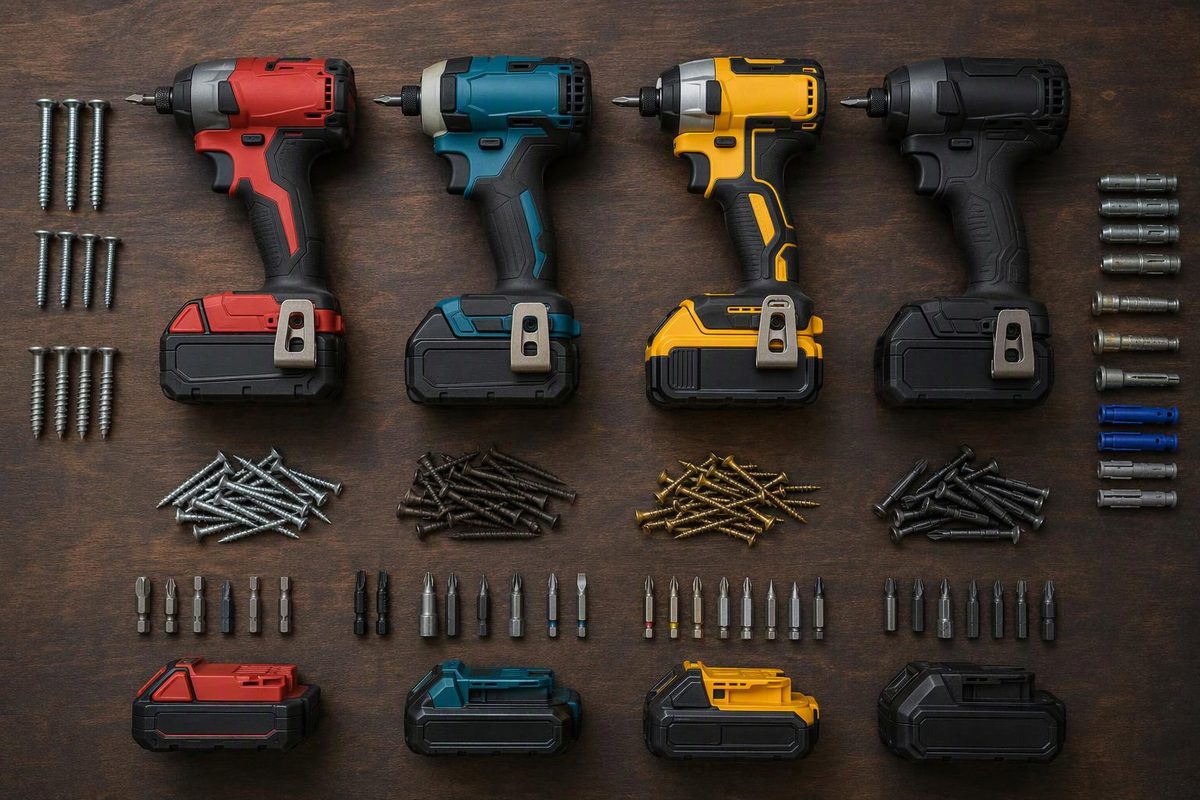
Start with the connection: these tools use a 1/4-inch hex bit shank, not a 1/4-inch screw diameter. Match the bit’s tip to the screw recess and exact size, then confirm that the fastener manufacturer permits impact driving in your material. Our impact-driver bit guide explains shank fit, insert holders and tip selection.
For general fastening, the Milwaukee M18 FUEL 2953-20 is our all-round pick from this shortlist: its 4.47-inch body, four-mode control and 2,000 in-lb rated torque offer a useful balance of access and output. Choose the Makita XDT20Z for its starting and tightening modes, the DeWalt DCF860B when higher rated output is the priority, or the Milwaukee M12 FUEL 3453-20 if you want a 12V-platform driver.
These are specification-based recommendations, not hands-on test rankings or a comparison of every available driver. Models and specifications below are from the manufacturers’ U.S. listings, checked October 28, 2026.
Compare the four picks
| Selection priority | Model and battery platform | Manufacturer-rated maximum torque | Maximum no-load speed | Control features that matter |
|---|---|---|---|---|
| General fastening | Milwaukee M18 FUEL 2953-20, M18 | 2,000 in-lb | 3,900 RPM | Four-mode control, including a self-tapping screw mode |
| Starting and seating control | Makita XDT20Z, 18V LXT | 1,590 in-lb | 3,600 RPM | Four speeds, Assist Mode, two self-drilling screw tightening modes and reverse auto-stop |
| Higher rated output | DeWalt DCF860B, 20V MAX | 2,500 in-lb | 3,800 RPM | Three speed modes and a variable-speed trigger |
| A 12V-platform option | Milwaukee M12 FUEL 3453-20, M12 | 1,500 in-lb | 3,600 RPM | Four-mode control, including a dedicated self-tapping screw mode |
Maximum torque is not a fastening torque setting. It does not tell you how tightly a particular screw will be installed. Milwaukee’s manual warns that longer impacting increases tightness and can damage fasteners or workpieces; it directs users to check tightness with a hand torque wrench. Do not treat a speed selector as a calibrated torque control. Milwaukee operator’s manual
Which one fits your work?
Milwaukee 2953-20: the all-round starting point
Choose this if you want one driver for varied, impact-approved fastening jobs, particularly if you already own M18 batteries. Its short body helps with access, while the selectable modes give you alternatives to full-speed driving. Milwaukee lists compatibility with all M18 batteries and chargers. 2953-20 specifications
The self-tapping mode has a specific operating envelope—not universal protection against stripped screws. The manual says it is optimized for #8, #10 and #12 self-tapping screws, 1/2–1 inch long, in 18–22 gauge sheet metal. It also says the mode only operates when the trigger is pulled more than halfway; below that, the driver uses normal impacting. Check both the tool manual and screw manufacturer’s instructions for your connection. Mode instructions
Makita XDT20Z: choose the control features
Choose this when controlled starts and different metal-screw settings matter more than the highest advertised torque. Assist Mode starts slowly until tightening begins; the two Tightening Modes address self-drilling screws in thin or thick gauge metal. Reverse auto-stop is intended to limit over-loosening and dropped fasteners. These are aids, not guarantees against cross-threading or damaged work. Makita feature descriptions
Its listed length is 4-1/2 inches. If you are comparing Makita models rather than changing battery systems, see our XDT21 versus XDT20 comparison.
DeWalt DCF860B: choose higher rated output
Choose this for demanding, impact-approved driving if you already use DeWalt 20V MAX batteries. It has the highest rated torque in this shortlist, but that alone does not establish the fastest driving performance across different screws and materials.
DeWalt identifies the DCB2108 battery in the footnote supporting its rated-torque comparison. It also says speeds 1 and 2 are optimized for commonly used self-drilling and tapping screws, while explicitly directing users to the tool manual and screw instructions. The DCF860B is a bare tool: battery and charger are not included. DeWalt specifications and footnotes
The 20V MAX label refers to maximum initial voltage without load; nominal voltage is 18V. Do not read the label as a two-volt working-voltage advantage over an 18V platform. DeWalt voltage footnote
Milwaukee 3453-20: choose the M12 system
Choose this if you want an M12-platform driver rather than adding an 18V system. It retains four-mode control and a dedicated self-tapping screw mode, with compatibility across M12 batteries and chargers. 3453-20 specifications
Do not assume “12V” means the shortest tool: its listed 5-inch length is longer than the 2953-20’s 4.47 inches. Compare the complete tool-and-battery envelope where you actually need clearance.
Before you buy—or drive the first screw
- Compare complete working costs. If you own compatible batteries and a charger, compare bare tools. Starting from nothing, compare kits and their included battery model and capacity—not just the driver price.
- Specify the hole separately. Choose any required pilot or clearance hole from the selected fastener’s installation guidance for the substrate. A higher-output driver is not a substitute for the correct hole.
- Check a representative sample. Use the prescribed mode and installation speed, then inspect seating depth and the surrounding material before repeating the connection.
Works when: the selected fastener permits impact installation, the bit fits exactly, and the hole, mode and seating depth follow the installation instructions.
Fails when: extra impacting is used to force a mismatched connection or to chase a torque number. For delicate hardware or brass screws, choose controlled hand installation instead; see our brass-screw limits. If your main task is socket-driven nuts and bolts, start with impact wrench versus impact driver rather than this shortlist.