
What Is an Impact Driver? Match It to the Screw
How this site is written
Dimensions and compatibility depend on the exact fastener, material, tool, and manufacturer. We show the matching logic and name the source; verify the packaging and tool manual before drilling or driving.
An impact driver uses twisting blows to drive screws. Learn its 1/4-inch hex bit fit, how it differs from a drill, and when to use another tool.
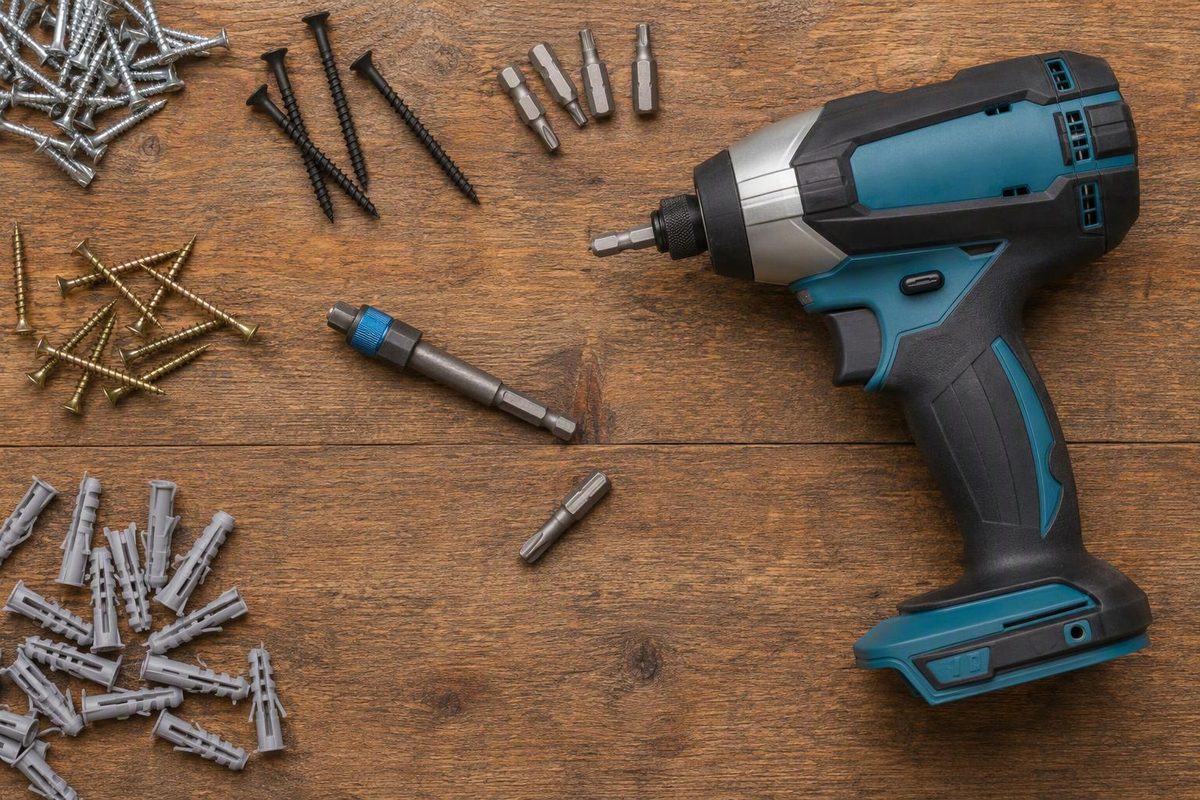
An impact driver is a power tool for driving and removing screws using rotation plus short, repeated twisting blows. Most use a 1/4-inch (6.35 mm) hex bit holder, rather than a drill’s adjustable chuck. That measurement describes the bit shank—not the screw diameter or the size of its drive recess. DeWalt’s tool comparison explains the hex drive and rotational impact action.
It is useful for repeated screw driving and long screws that need substantial torque—turning force—provided the fastener manufacturer permits impact installation. It is not automatically the right choice for delicate hardware, drilling holes or tightening a joint to a specified torque.
What the “impact” does
A conventional impact driver turns smoothly under light load. As resistance increases, its hammer-and-anvil mechanism delivers rapid blows in the direction of rotation. Those pulses help turn the fastener; they do not hammer it straight into the work like a nail. The mechanism also produces the familiar rattling sound. Pro Tool Reviews describes how the mechanism works.
Impact driver vs. drill, hammer drill and impact wrench
| Tool | Identifying feature | Main use |
|---|---|---|
| Impact driver | Usually a 1/4-inch hex bit holder; twisting impacts | Driving screws where impact installation is suitable |
| Drill/driver | Adjustable chuck; steady rotation; commonly an adjustable driving clutch | Drilling pilot holes and driving screws with more control |
| Hammer drill | Drill chuck plus a selectable forward hammering action | Drilling suitable masonry with the correct masonry bit |
| Impact wrench | Usually a square drive for sockets | Loosening and fastening larger nuts and bolts |
The key distinction is twisting impacts versus forward hammering. A hammer drill helps a masonry bit cut into the material; an impact driver helps turn a fastener. See the drill and hammer-drill explanation and DeWalt’s impact-wrench comparison.
An impact driver can drill some holes with suitable impact-ready accessories, but an ordinary round-shank drill bit will not fit its hex holder directly. For a beginner, a drill/driver remains the straightforward choice for pilot holes. DeWalt describes using impact-ready bits or its DW0521 chuck adapter; check compatibility with your particular tool before fitting an adapter.
Match the bit before driving
Check three things separately:
- Shank fit: Use the shank and retention geometry specified by the tool manual. Confirm the bit locks securely; do not assume every short 1/4-inch hex insert bit fits directly.
- Tip fit: Match the screw’s drive profile and exact size—Phillips, Torx, square or hex. A correct shank does not establish a correct tip.
- Impact suitability: Choose bits, holders and nut setters intended for impact use. A hex shank alone is not an impact rating.
Makita’s XDT13 manual specifies retention geometry and correct tip fit; Milwaukee’s impact-accessory guide distinguishes impact-duty accessory types. For the detailed matching sequence, see driver bits for impact drivers.
Works when—and fails when
Works when: The screw, substrate and installation instructions allow impact driving; the bit fits properly; and any required pilot hole is drilled first. Impact power does not cancel a pilot-hole requirement. Use the selected fastener’s instructions rather than a universal hole size.
Fails when: You overdrive a screw beyond its required seating depth, use the wrong tip or treat a speed mode as a calibrated torque setting. Excessive impact force or driving time can strip or damage the screw and bit. Makita recommends a test operation and checking bolt torque with a torque wrench. Source: XDT13 manual.
Start slowly, hold the bit straight and reduce speed as the head approaches its seat. Test on representative scrap before committing to finished work. Use a hand screwdriver for brass screws and delicate fittings; see brass-screw uses and limits. Wear eye and hearing protection, and remove the battery before changing accessories, as directed in the tool manual.