
The FX1372 Improves Handling, Not Driving Power
Compare FLEX FX1372 and FX1371 torque, speed, weight, size, collets, kits, and test times to see whether the newer impact driver earns an upgrade.
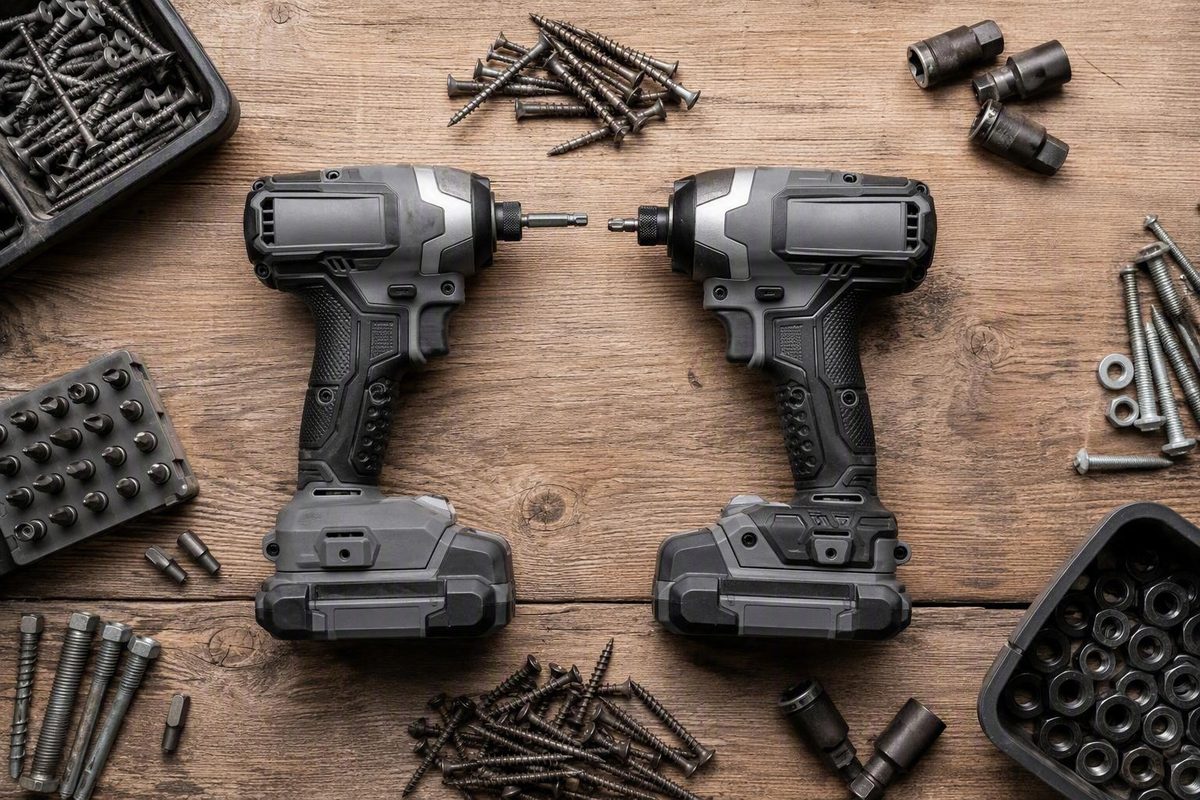
The FLEX FX1372 is the better choice for most new FLEX 24V buyers, but most FX1371 owners should keep their current driver. The FX1372 is 0.35 inch shorter, 0.4 lb lighter as a bare tool, and easier to reload, yet both models are rated at 2,500 in-lbs and produced nearly identical times in the available direct tests.
Select your buying situation and bit-change workload; the tool compares specifications, packages, and potential time saved.
Compare the documented configurations, calculate a bit-change scenario, and select the improvements that matter in your work.
| Specification | FX1371 | FX1372 |
|---|---|---|
| Documented kit price | — | $299 launch price |
| Package | FX1371A-1H: one 6.0Ah Stacked Lithium battery, 280W charger, case | FX1372A-2C: two 5.0Ah batteries, 160W charger, hard case |
| Published maximum torque | 2,500 in-lbs | 2,500 in-lbs |
| Top no-load speed | 4,000 RPM | 4,100 RPM |
| Top impact rate | 4,450 IPM | 4,550 IPM |
| Head length | 4.75 in | 4.40 in |
| Bare-tool weight | 2.8 lb | 2.4 lb |
| Weight with 5.0Ah battery | ~4.9 lb | ~4.6 lb |
| Bit mechanism | Quick Eject releases bit | One-Touch actively ejects bit |
| Lighting | Foot-mounted LED | 360° LED ring, 5 settings |
| Operating modes | 3 standard + 2 self-tapping | 3 standard + 2 self-tapping |
The current FX1371 kit price was not supplied. The packages also have different batteries and chargers.
No measured per-change saving was supplied, so enter your own observed or expected value.
Sources: FLEX published specifications and package details; Pro Tool Reviews direct comparison and test results. “~” marks approximate working weights; “—” means the supplied evidence does not provide a price.
Buy the FX1372 if you frequently change bits, work overhead or in confined spaces, or need better illumination. Consider a discounted FX1371 if those refinements do not matter. A reliable FX1371 does not need replacing for torque or driving speed alone.
This comparison uses manufacturer specifications and third-party testing rather than an independent B Power Tools head-to-head test. The principal evidence is the direct FX1372 and FX1371 comparison from Pro Tool Reviews and FLEX’s official FX1372 product page.
The FX1372 Keeps the Same Torque but Cuts Size and Weight
Both models are 24V brushless impact drivers with a 1/4-inch hex collet. They share three standard speed modes, two self-tapping modes, and the same published maximum-torque rating.
| Specification or feature | FLEX FX1371 | FLEX FX1372 |
|---|---|---|
| Voltage | 24V DC | 24V DC |
| Motor | Brushless | Brushless |
| Collet | 1/4-inch hex | 1/4-inch hex |
| Published maximum torque | 2,500 in-lbs | 2,500 in-lbs |
| Speed range 1 | 0–1,900 RPM | 0–1,500 RPM |
| Speed range 2 | 0–2,700 RPM | 0–2,000 RPM |
| Speed range 3 | 0–4,000 RPM | 0–4,100 RPM |
| Impact-rate range 1 | 0–1,300 IPM | 0–3,000 IPM |
| Impact-rate range 2 | 0–3,600 IPM | 0–4,000 IPM |
| Impact-rate range 3 | 0–4,450 IPM | 0–4,550 IPM |
| Bare-tool weight | 2.8 lb | 2.4 lb |
| Weight with 5.0Ah battery | Approximately 4.9 lb | Approximately 4.6 lb |
| Head length | 4.75 inches | 4.40 inches |
| Standard modes | 3 | 3 |
| Self-tapping modes | 2 | 2 |
| Bit release | Handle-mounted Quick Eject control | One-Touch active ejection |
| Lighting | Foot-mounted LED | 360-degree LED ring with 5 settings |
| Bit holders | Single-holder layout | Two-bit holder |
| Belt-hook mounting | Left-side-only mount reported | Two-position arrangement |
| Battery platform | FLEX 24V | FLEX 24V |
The FX1372 is faster only at the top of mode 3, where its published ceiling increases from 4,000 to 4,100 RPM. Its first two settings have lower ceilings: 1,500 instead of 1,900 RPM in mode 1 and 2,000 instead of 2,700 RPM in mode 2. The older ranges also appear on FLEX’s official FX1371 product page.
Those lower ceilings may make the first two settings easier to manage when controlled fastening matters more than maximum speed. That is an interpretation of the ranges, not evidence that the FX1372 has a better trigger or seats fasteners more consistently.
All three FX1372 settings have higher published impact-rate ceilings. RPM and IPM still do not predict application speed by themselves. Torque delivery, electronics, battery condition, fastener geometry, material, and the point at which the impact mechanism comes under load also affect completion time.
Direct Tests Show No Meaningful Speed Advantage
Equal maximum-torque specifications do not support calling the FX1372 substantially stronger. Both tools carry a published rating of 2,500 in-lbs, and that number is a manufacturer specification rather than an independently measured result.
In Pro Tool Reviews’ RSS structural-screw test, the FX1372 averaged 5.84 seconds and the FX1371 averaged 5.86 seconds. The difference was 0.02 second.
In the same publication’s bolt-break test, the averages were 1.74 seconds for the FX1372 and 1.75 seconds for the FX1371. That difference was 0.01 second.
Those results do not establish a meaningful real-world speed advantage. The FX1372’s additional 100 RPM and 100 IPM at the top of mode 3 did not produce a material lead in either reported procedure.
The findings should be read narrowly. Results can change with battery type and charge state, selected mode, fastener diameter and thread design, material density and moisture, tool temperature, timing criteria, and variation between individual tools. Unrelated tests involving other brands should not be combined with these results because their batteries, fasteners, materials, and procedures differ.
The supported description is that the FX1372 is refined rather than substantially more powerful.
The Shorter, Lighter Body Is the Strongest Upgrade
The FX1372 measures 4.40 inches long and 2.4 lb bare, compared with 4.75 inches and 2.8 lb for the FX1371. The newer driver is therefore approximately 0.35 inch shorter and 0.4 lb lighter without a battery.
That reduction matters most where the chuck, fastener, tool body, and user’s hand must fit within a restricted opening. The FX1372 has an advantage inside cabinets, between framing members, beside mechanical equipment, and anywhere a longer head forces the bit off-axis. Open framing and bench assembly provide less reason to change tools.
The lower bare weight should also make the FX1372 easier to raise and reposition, especially overhead. The available comparison did not measure fatigue, so it cannot support a quantified endurance claim.
With the same 5.0Ah battery, the reported weights were approximately 4.6 lb for the FX1372 and 4.9 lb for the FX1371. Battery choice can partly overshadow the difference between the tool bodies and can make either driver feel bottom-heavy. The evidence does not compare the two models using matched smaller packs.
For an FX1371 owner, handling is the best reason to upgrade. If the older driver repeatedly fails to fit or its working weight is a persistent overhead burden, the FX1372 addresses a defined problem. Otherwise, the improvement remains incremental.
One-Touch Ejects the Bit Instead of Merely Releasing It
The names One-Touch and Quick Eject describe related but different mechanisms.
The FX1371’s Quick Eject control sits above the trigger. Operating it moves the collet forward and releases the bit while the user keeps the operating hand on the grip. It does not actively spring the accessory out, so the user may still have to pull the released bit from the collet.
The FX1372’s One-Touch mechanism releases and actively ejects the bit. This removes the final manual pull from a change.
That distinction matters to installers who repeatedly move among Phillips, Torx, square, hex, and nut-setting accessories. Someone who installs one bit at the beginning of a job and leaves it in place will gain little. Users must also pay attention to where an ejected accessory will land.
No supplied endurance test establishes that either design is more reliable over time. There is no multi-unit evidence covering retention, collet wear, debris resistance, or the FX1372 ejection spring’s service life. The defensible advantage is workflow, not proven durability.
The calculator above deliberately asks the user to enter an estimated number of seconds saved per change. The supplied testing did not measure that interval, so a fixed time-saving claim would be unsupported.
The LED Ring and Accessory Layout Improve Daily Use
Both drivers retain three standard modes and two self-tapping modes. FLEX says the FX1372’s self-tapping settings automatically control speed while setting self-tapping screws. That is the manufacturer’s description, not independent proof that the newer modes outperform the FX1371 in every fastener and material.
Lighting is a clearer physical change. The FX1371 uses an LED at the foot of the tool. The FX1372 places a 360-degree LED ring with five settings around the nose.
The ring distributes light around the bit and fastener, while its settings let the user adjust output for the work area. That arrangement is more versatile inside cabinets, beneath counters, and in mechanical spaces where the body of the tool can obstruct a lower light. No supplied test reports beam pattern, lux, color quality, or measured shadow reduction.
The FX1372 also has a two-bit holder and a two-position belt-hook arrangement. The documented FX1371 layout has a single holder and a left-side-only belt-hook mount. These convenience changes may affect daily work more often than the additional 100 RPM at the top setting.
None of these features proves longer runtime, better thermal control, lower vibration, or greater sustained output. Those comparisons have not been supplied.
The Two Documented Kits Are Not Equivalent
The documented newer package is the FX1372A-2C, containing the FX1372A-Z driver, two 5.0Ah lithium batteries, a 160W charger, hard case, bit holder, belt clip, No. 2 Phillips bit, and T25 bit. Its documented launch price is $299.
The documented older FX1371A-1H package contains the FX1371 driver, one 6.0Ah Stacked Lithium battery, a 280W rapid charger, case, bit holder, belt clip, No. 2 Phillips bit, and T25 bit.
These packages cannot be compared by sticker price alone. One supplies two conventional 5.0Ah batteries and a 160W charger; the other supplies one 6.0Ah Stacked Lithium battery and a 280W charger. The draft evidence does not provide a current FX1371 kit price or configuration-matched bare-tool prices, so those figures are shown as unknown in the comparison tool.
Compare bare tool with bare tool whenever possible. For kits, account for battery count, capacity and construction, charger power, case, and accessories you will actually use. Existing FLEX 24V owners may need only the tool.
FLEX lists a five-year warranty when the tool is registered within 30 days and a three-year warranty without registration for the documented FX1372 product. The official FX1371 page documents the same terms for that package. Older references to promotional lifetime coverage should not be treated as current buying guidance.
Prices, availability, package contents, and warranty terms can change. Verify the live listing before purchase.
New Buyers Should Favor the FX1372; Most Owners Should Keep the FX1371
| Buyer or use case | Better choice | Reason |
|---|---|---|
| First FLEX 24V purchase | FX1372 if comparable pricing is close | Smaller body, lower weight, active ejection, and improved lighting without a measured performance loss |
| Current FX1371 owner | Keep the FX1371 in most cases | Direct screw and bolt tests show no meaningful speed gain |
| Frequent bit changes | FX1372 | One-Touch actively ejects the released accessory |
| Tight-space or overhead work | FX1372 | Shorter head and lower bare weight address access and handling |
| Dim work areas | FX1372 | Five-setting 360-degree LED ring is more versatile |
| Torque- or speed-focused purchase | Either | Same published torque and virtually identical direct test times |
| Discount-driven purchase | Compare equivalent packages | An FX1371 can be the better value when its convenience disadvantages do not matter |
For a new buyer, the FX1372 is the sensible default when the configuration-matched price difference is modest. For an existing owner, an upgrade makes sense only when the shorter head, reduced weight, active ejection, or LED ring solves a recurring problem.
There is no responsible fixed-dollar upgrade threshold without current prices for equivalent configurations. The evidence also lacks a matched runtime comparison, sustained thermal test, vibration measurement, multi-unit reliability study, and long-term durability comparison.
Pay more for the FX1372’s handling and workflow improvements, not for an expectation of dramatically greater driving power.