
Choose the Impact Tool by the Fastener, Not the Headline Torque
Screws favor a driver and sockets favor a wrench. A driver may still be enough when socket work is occasional, accessible, and light.
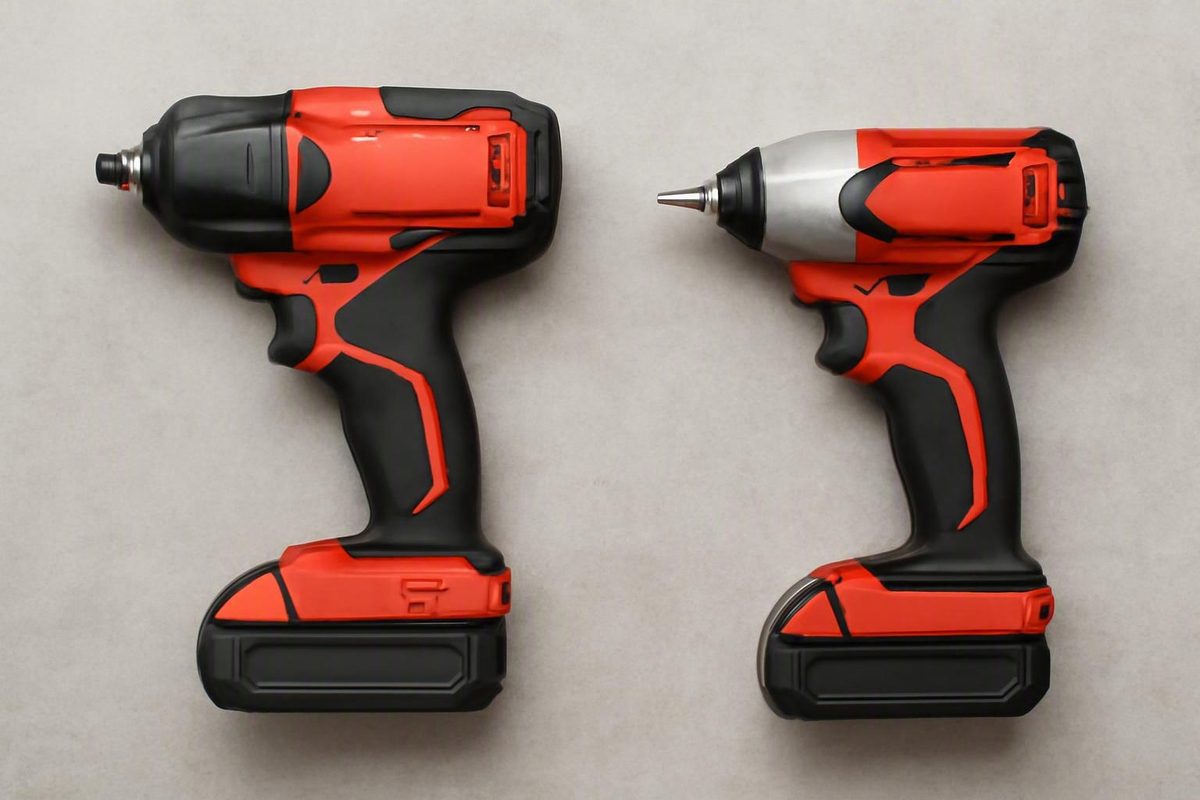
Choose the impact tool by the fastener, not the headline torque.
The quick answer: screws favor a driver, sockets favor a wrench
Choose an impact driver when most of your work involves screws, driver bits, and accessories with a 1/4-inch hex shank. Choose an impact wrench when the recurring job involves sockets, nuts, and external bolt heads.
The output interface is the most useful difference:
- An impact driver usually has a quick-change 1/4-inch hex collet.
- An impact wrench usually has a square anvil, with 3/8-inch and 1/2-inch among the commonly encountered drive sizes.
Impact wrenches generally occupy the higher-output end of the market and are intended for more demanding bolted connections. Impact drivers are generally smaller and easier to maneuver around cabinetry, framing, and other screw-driven work. These are class-level tendencies rather than universal rules: compact wrenches and powerful drivers create overlap between individual models. Manufacturer comparisons likewise distinguish the tools primarily by their interfaces and intended fasteners (DEWALT’s impact driver and impact wrench overview).
| Comparison point | Impact driver | Impact wrench |
|---|---|---|
| Output interface | Usually a 1/4-inch hex collet | Usually a square anvil; 3/8-inch and 1/2-inch are common |
| Primary fasteners | Screws, structural screws, and smaller fasteners driven with hex-shank accessories | Nuts, bolts, and other socket-driven fasteners |
| Common projects | Decking, cabinetry, furniture, light framing, drywall, and household repair | Vehicle work, machinery, suspension, wheel-lug removal, and stubborn bolts |
| Relative size and maneuverability | Generally compact and easy to position | Generally larger and oriented toward greater output, although compact models exist |
| Accessory type | Hex-shank driver bits and compatible accessories | Impact sockets, extensions, and square-drive accessories |
| Principal limitation | Not a dependable substitute for a wrench in sustained or demanding socket work | Less natural for routine screw-driving and delicate fastening |
The immediate buying recommendations are straightforward:
- Routine household and woodworking fasteners: Buy an impact driver first.
- Predominantly mechanical or automotive socket work: Buy an impact wrench, selecting its drive size and output for the work and sockets you use.
- Regular woodworking plus mechanical repair: Own both. Native interfaces are more convenient and avoid making an adapter the weak link in every crossover job.
The phrase impact wrench vs impact driver makes the choice sound like a contest with one overall winner. It is not. These tools belong to related but distinct fastening systems. The better tool is the one designed for the accessory and fastener in front of you.
How both tools create impact—and why neither is a hammer drill
An impact driver and an impact wrench both turn fasteners through repeated rotational impacts. When resistance rises, an internal hammer mechanism delivers short twisting blows to the output instead of relying only on smooth, continuous motor force.
Those pulses can provide substantial driving or loosening force while limiting the continuous reaction torque transferred to the operator compared with an ordinary drill or hand ratchet. That does not eliminate movement, noise, or the need for a secure grip. It explains why an impact tool feels different even when it is turning the same kind of fastener.
A hammer drill works differently. It adds blows along the drilling axis—forward into the work—to help a suitable bit penetrate hard material such as masonry. Impact drivers and impact wrenches primarily deliver their blows in the direction of rotation. Worx’s mechanism guide distinguishes the rotational action of impact tools from the longitudinal action of a hammer drill (Worx’s guide to impact tools and hammer-drill action).
That distinction points to the appropriate tool:
- A screw resisting rotation may call for an impact driver.
- A nut or bolt resisting rotation may call for an impact wrench.
- A masonry hole may call for a hammer drill or another specified masonry tool.
- An ordinary hole in wood or metal will usually be better served by a drill/driver and the correct bit.
Tool specifications also describe different aspects of performance:
- RPM, or revolutions per minute, indicates rotational speed.
- IPM, impacts per minute, and BPM, blows per minute, indicate impact frequency.
- Torque describes turning effect.
- Fastening output and loosening or breakaway output may be listed separately.
These measurements are not interchangeable. A higher impact rate does not automatically establish greater torque, and a larger torque claim does not prove that a tool will complete every task faster. Two models may behave differently because of their hammer mechanisms, control systems, batteries, accessories, dimensions, or the condition of the fastener.
Use RPM and IPM to understand how a particular model is configured, not as substitutes for application guidance. The largest advertised number is not enough information to choose between two different tool classes.
Drive interface and accessories: the difference you can see
The output interface tells you what each tool was built to hold.
An impact driver’s quick-change 1/4-inch hex collet accepts compatible hex-shank driver bits and accessories. Pull or slide the collet as directed by the manufacturer, insert the bit, and confirm that it has locked into place. This arrangement suits work in which the operator frequently changes among Phillips, Torx, square, hex, nut-driver, and other fastening bits.
An impact wrench’s square anvil accepts a socket or another compatible square-drive accessory. The socket surrounds the outside of a nut or bolt head so the tool can turn it. Common wrench drive sizes include 3/8 inch and 1/2 inch, although smaller and larger formats exist. Drive size is not a universal torque boundary; it is an accessory, fastener, clearance, and intended-application decision (Kreg’s impact wrench and impact driver comparison).
The native accessory follows the shape of the fastener:
- Recessed screw head: Use a correctly fitted driver bit.
- External nut or bolt head: Use a correctly sized socket.
- Hex-head screw used with a hex-shank nut setter: Often a natural impact-driver application, subject to the fastener instructions.
- Large socket-driven bolted connection: Usually an impact-wrench application.
A hex-to-square adapter allows an impact driver to accept some sockets. That can be useful when a screw-focused tool kit occasionally encounters accessible, light-duty nuts or bolts. It is crossover capability, however—not evidence that the driver has become a native impact wrench.
An adapter adds length and another joint to the assembly. It may introduce wobble, wear, uncertain power transfer, and another potential failure point. A stack consisting of the collet, adapter, extension, and socket can also become awkward in confined spaces. These drawbacks matter more when socket work is frequent or demanding.
Use impact-rated bits, sockets, extensions, and adapters. Inspect them before use for cracks, deformation, excessive wear, or other damage, and secure sockets with the retention system specified for the wrench. The Power Tool Institute advises using impact-designated accessories, inspecting sockets, and following the tool manufacturer’s instructions (Power Tool Institute impact-tool safety guidance).
Do not choose between wrench drive sizes by applying a made-up universal torque cutoff. Instead, check:
- Which impact sockets you own or can readily obtain
- The sizes of the fasteners you encounter
- Whether the tool and socket fit the available space
- The applications identified in the model’s manual
- Whether compact dimensions or greater output better suit the recurring job
- How the socket is retained on that particular anvil
The accessory system is part of the tool. A powerful motor cannot compensate for a cracked socket, loose adapter, poorly fitted bit, or incorrect drive size.
Task-by-task comparison: which tool fits the actual job?
The following matrix begins with the accessory that naturally engages the fastener. The recommendations describe intended use, not an absolute claim about what another tool might accomplish under favorable conditions.
| Task | Native accessory | Recommended tool | Qualification |
|---|---|---|---|
| Deck screws | Correct hex-shank driver bit | Impact driver | Match the bit to the recess and control the final seating depth. |
| Cabinetry and furniture assembly | Driver bit | Impact driver | Use restraint around small hardware, finished surfaces, and delicate materials. A drill/driver or hand tool may provide better control for final seating. |
| Drywall fastening | Driver bit or depth-setting accessory | Impact driver, where appropriate | Avoid overdriving and damaging the paper face; a dedicated drywall tool may be preferable for volume work. |
| Light framing and routine home repairs | Driver bit or nut setter | Impact driver | A natural fit when screw-style fasteners dominate. |
| Structural screws | Manufacturer-specified driver bit | Usually an impact driver | Follow the fastener maker’s requirements for the bit, pilot hole, embedment, and installation method. |
| Lag fasteners | Driver bit, nut setter, or socket, depending on the head | Driver or wrench, depending on design and size | Screw-style fasteners often suit a driver; large socket-driven hardware may favor a wrench. |
| Mower and small-engine hardware | Impact socket | Compact impact wrench | The direct choice when most fasteners are nuts and bolt heads. A driver and adapter may handle occasional light hardware. |
| Wheel-lug removal | Impact socket | Impact wrench | Removal depends on the tool, battery, socket, fastener condition, and prior tightening. Use a separate final-tightening process. |
| Suspension work | Impact socket | Impact wrench | Follow the vehicle service procedure. Seek qualified help if approved ordinary removal methods do not work. |
| Corroded or seized bolts | Impact socket | Impact wrench | No impact tool guarantees removal; fastener and thread condition still matter. |
| Large machinery fasteners | Impact socket | Impact wrench | Select the drive, socket, and tool according to the machine manufacturer’s procedure. |
| General drilling | Drill bit held in a chuck | Drill/driver | An impact driver can drill only with compatible hex-shank accessories and is not the most versatile drilling tool. |
| Masonry drilling | Suitable masonry bit | Hammer drill or specified masonry tool | The application requires axial hammering rather than rotational impact fastening. |
Decks, cabinets, furniture, drywall, and light framing generally favor an impact driver because the work centers on screw heads and hex-shank bits. The compact nose can also help when fastening between framing members or inside cabinets. It does not guarantee perfect control: bit fit, trigger technique, operating mode, fastener, and substrate still affect the result.
Structural screws and lag fasteners require more qualification. “Lag” can describe fasteners with different sizes, head styles, and installation requirements. Check whether the fastener calls for a pilot hole, which bit or socket it requires, and whether installation with an impact tool is permitted. A long structural screw with a compatible drive recess may be routine impact-driver work; large hardware driven through heavy members may be more naturally handled with a socket and impact wrench.
Wheel lugs, suspension bolts, seized fasteners, and machinery hardware favor an impact wrench because they are native socket applications and may require greater removal force. Tool-industry comparisons similarly place screw-driving and cabinetry on the driver side while assigning lug nuts, machinery, and stubborn fasteners to the wrench side.
Small-engine repair sits near the overlap. If mower, generator, or motorcycle work mostly involves sockets on nuts and bolt heads, a compact impact wrench is the direct fit. A driver with an impact-rated socket adapter can be convenient for occasional light hardware, especially for someone who also does substantial household screw-driving.
A forum discussion illustrates why no universal crossover promise is sensible: some participants describe satisfactory driver-and-adapter use for light mechanical work, while others favor a compact square-drive wrench or report adapter wear and breakage under heavier loads. These accounts show conflicting user experience, not controlled evidence that every tool will perform the same way (Garage Journal discussion of drivers, wrenches, and socket adapters).
Whether a particular fastener moves can depend on:
- Rust and contamination
- Thread or fastener damage
- Previous tightening
- Tool model and operating mode
- Battery state and compatibility
- Socket or bit fit
- Adapter and extension arrangement
- Access and alignment
The important distinction is between intended use and occasional capability. A driver may remove some nuts, and a wrench could turn adapted bits. Neither fact makes the crossover arrangement ideal for repetitive work.
Can an impact driver replace an impact wrench?
Sometimes—but only within a limited boundary.
An impact driver may be sufficient when socket work is occasional, accessible, and light. If you already own a driver and need to remove a small cover bolt or run down a modest nut, a sound impact-rated hex-to-square adapter can be a reasonable convenience. Begin under control and stop if the adapter, socket, tool, or fastener behaves abnormally.
That does not make a driver a reliable universal replacement for an impact wrench. Success depends on the complete system:
- The specific impact driver and operating mode
- Battery charge, condition, and compatibility
- The strength and fit of the adapter
- Socket condition and size
- Extension length and alignment
- Fastener size and condition
- The force required to start the fastener moving
A demonstration showing one driver removing one lug nut or mower bolt proves only that the particular setup worked in that instance. It does not establish how the fastener was previously tightened or whether a different vehicle, battery, adapter, or fastener condition would produce the same result.
Avoid making sustained, demanding socket work the routine duty of a driver adapter. The extra joint can wear, wobble, or break, and it lengthens the assembly. If you repeatedly reach for sockets, a compact impact wrench is probably less specialized than it first appears—it is the native tool for your actual work.
A practical boundary is:
- Occasional, accessible, light hardware: A driver with a sound impact-rated adapter may be adequate.
- Repeated mower or small-engine socket work: A compact impact wrench is usually the cleaner setup.
- Regular automotive work, stubborn fasteners, or larger bolted connections: Use a suitable impact wrench.
- Critical final tightening: Change to the specified hand tool or calibrated torque wrench.
Do not assume every impact driver can remove lug nuts. Do not assume no driver ever can. Occasional success and suitability for recurring work are different questions.
Torque claims, lug nuts, and accurate final tightening
Maximum torque is easy to compare on a product page and difficult to interpret across manufacturers. A headline rating should not be treated as proof that a tool will remove a particular fastener.
Several different ideas are often collapsed into one number:
- Fastening capability: Installing and tightening a fastener
- Loosening or breakaway capability: Starting a stationary fastener moving in reverse
- Rotational speed: Usually expressed in RPM
- Impact frequency: Usually expressed in IPM or BPM
- Accurate final tightening: Bringing a joint to a prescribed specification within an accepted tolerance
These are not equivalent. Published figures may come from different tool configurations, batteries, accessories, test arrangements, and definitions. Fastener condition also varies. Category-wide “average torque” figures are therefore less useful than model-specific specifications and application guidance.
An impact wrench is not a calibrated torque wrench. It can remove tight fasteners and bring components together quickly, but repeated hammer blows do not provide the controlled final measurement of an appropriate calibrated torque tool. Selectable speed, automatic-stop, and assist modes may improve control, but they do not make the impact wrench a calibrated final-tightening instrument.
For wheel lugs, use a disciplined procedure:
- Follow the vehicle manufacturer’s instructions for preparing and supporting the vehicle.
- Use a suitable impact socket and tool for removal.
- Inspect the relevant components as required by the vehicle procedure.
- Position the wheel correctly.
- Hand-start every lug so crossed threads can be identified before power is applied.
- Snug the lugs cautiously in the prescribed pattern without prolonged impacting.
- Complete the vehicle’s prescribed lowering or stabilization procedure.
- Tighten each lug in the specified pattern to the vehicle manufacturer’s value with a calibrated hand torque wrench.
Do not substitute a generic internet value for the vehicle manufacturer’s application-specific specification. The impact tool may speed removal and initial snugging, but the calibrated torque wrench completes the measurement-critical stage.
Excessive or prolonged impacting can strip threads, break bolts, damage fasteners, or overtighten a joint. Industry safety guidance advises avoiding over-impacting and completing low-torque or critical final tightening with an appropriate hand torque wrench (PTI guidance on over-impacting and final tightening).
The same principle applies beyond wheels. Small-engine covers, furniture connectors, structural assemblies, and machine components can be damaged before a powerful impact tool appears strained. Use the impact tool for the stage it handles well, then change tools when measurement or tactile control becomes more important than speed.
Can an impact driver drill holes?
An impact driver can perform limited drilling with compatible hex-shank drill bits and other accessories designed for the tool. This can be useful for an occasional pilot hole when carrying a separate drill would be inconvenient.
Suitable hex-shank accessories may permit limited drilling in materials such as wood, plastic, or thin aluminum, provided the accessory manufacturer permits the application. These are qualified examples, not guarantees that every driver, bit, hole size, or material combination will work well (Axa Tool’s impact-driver drilling overview).
An impact driver does not directly accept every ordinary round-shank drill bit. Its collet is designed for a compatible hex shank.
A drill/driver remains the more versatile general drilling tool because it:
- Accepts a broader range of drill-bit shanks through an adjustable chuck
- Is designed primarily for drilling and controlled driving
- Usually provides smoother continuous rotation
- Often includes a clutch for low-torque screw work
- Offers better control when starting a precise hole
- Accommodates a wider selection of specialty drilling accessories
For demanding use with an impact mechanism, choose accessories explicitly rated for impact operation and follow both the tool and bit manufacturers’ compatibility instructions. A bit that fits the collet is not necessarily approved for every material, speed, or impact load.
A hammer drill is the relevant alternative when the job requires axial blows into hard masonry. It is not simply a stronger impact driver. If the recurring work is making holes rather than turning fasteners, begin with the appropriate drilling tool and treat the impact driver as a fastening specialist with limited drilling capability.
In short, an impact driver can handle occasional compatible drilling. It does not completely replace a drill/driver.
Buying guide: driver, wrench, or both?
Begin with the fastener you handle most often.
If you usually see screw recesses and reach for hex-shank bits, buy an impact driver. If you usually see nuts and external bolt heads and reach for sockets, buy an impact wrench. This fastener-first method is more dependable than comparing the largest torque figure printed on two unrelated boxes.
An impact driver is often the more broadly useful first impact tool for furniture assembly, decks, cabinetry, framing, and household fastening. It also complements a drill/driver: the drill can remain fitted with the drilling bit while the impact driver carries the screw-driving bit.
A compact impact wrench makes more sense when work centers on small engines, vehicle maintenance, machinery, trailers, or other socket-based repair. Choose enough output for the intended applications, but do not overlook compact dimensions and controllable operating modes around smaller hardware.
Own both when screw-driving and mechanical repair are regular activities. The benefit is not merely having two motors:
- The driver remains ready for bits and screws.
- The wrench remains ready for sockets and bolts.
- There is less adapter swapping.
- Each tool can be selected for the required output, control, and workspace.
When comparing models, look beyond maximum torque:
- Drive type and size: Confirm that the interface matches your bits or sockets.
- Dimensions: Check head length, body width, battery shape, and clearance around the output.
- Weight: Consider working weight with the battery and accessory attached.
- Speed and assist modes: Lower settings may improve control, although they do not guarantee a particular final torque.
- Accessory availability: Confirm that suitable impact-rated sockets, bits, extensions, and adapters are readily available.
- Battery compatibility: An existing battery platform may reduce total cost and simplify charging.
- Work-light placement: Check whether the accessory shadows the fastener.
- Workspace: Under-hood access, cabinet interiors, overhead work, and open machinery bays impose different requirements.
- Frequency of use: Repetitive demanding work may justify a more specialized tool than occasional repair.
- Budget: Include batteries, charger, sockets, bits, extensions, and any required torque tools—not only the bare-tool price.
Cordless tools avoid hoses and compressors, improving portability and setup convenience. Pneumatic impact tools require a compatible compressor, hose, and air-delivery arrangement. That distinction alone does not establish that one power source is categorically stronger; compare specific tools and the workload.
Read model-specific manuals and specification sheets before buying. Check intended applications, battery or air requirements, accessory retention, dimensions, and operating modes. Unsupported category averages cannot tell you whether a particular model will fit beside a suspension component, control a small furniture screw, or accept the sockets already in your cabinet.
Four-profile recommendation
- Household DIY: Start with an impact driver if most projects involve shelves, repairs, furniture, and screws. Add a drill/driver if you do not already own one.
- Woodworking or construction fastening: Choose an impact driver for repetitive screw and structural-screw work, subject to the fastener instructions. Keep a drill/driver for holes and more delicate driving.
- Small-engine repair: Choose a compact impact wrench if sockets dominate. Add a driver if household screw work is also frequent.
- Frequent automotive work: Buy a suitable impact wrench and impact sockets. Keep a calibrated torque wrench for final tightening; add an impact driver for screw-based projects.
The decision is about recurring work, not theoretical versatility. A driver adapted to sockets may seem economical until adapters become a daily inconvenience. A wrench adapted to bits may appear powerful until its interface and output make routine screw work awkward.
Safe setup and use for either impact tool
General precautions cannot replace the manuals for the specific tool, battery, charger, socket, bit, adapter, extension, and fastener system. Read those instructions before use, especially when changing operating modes, drive sizes, or retention components.
Use this setup routine:
- Select the correct tool. Use the driver for compatible hex-shank fastening accessories and the wrench for square-drive socket work.
- Select an impact-rated accessory. Confirm that the bit, socket, extension, or adapter is intended for impact use and matches the required drive.
- Inspect the assembly. Look for cracked sockets, rounded drive openings, worn bits, bent extensions, damaged adapters, or compromised retaining components.
- Disconnect power before changing accessories. Remove the battery or otherwise disconnect the tool as directed by its manufacturer.
- Secure the accessory properly. Confirm that the bit locks into the collet and that the socket is held by the specified retention system.
- Check the work area. Maintain stable footing, adequate lighting, and clearance from other people.
- Wear appropriate protection. Use eye protection against fragments and debris, and hearing protection around repeated impact noise.
- Control clothing and hair. Keep loose clothing, jewelry, hair, and other items away from the rotating accessory.
- Hold and position the tool as its manual directs. Keep the accessory properly seated and avoid forcing a poorly aligned setup.
- Start under control. Use a lower mode when appropriate and increase output only when the application requires it.
- Stop when the fastener seats or stops moving. Do not assume that prolonged impacting is harmless.
Eye protection, a proper grip, and control of loose clothing are standard precautions identified in manufacturer safety guidance (ONEVAN’s impact-tool safety overview). Follow the specific tool manual where its instructions are more restrictive.
A socket must be secured with the proper ring, pin, or other retention arrangement specified for the anvil. Never improvise with wire, nails, or soft pins. If the intended retaining component is missing or damaged, stop and replace it.
More trigger time is not always the correct response.
Be especially cautious with small, delicate, low-torque, or safety-critical fasteners. Run them down only as far as the procedure permits, then complete final tightening with the appropriate hand tool or calibrated torque wrench. An impact tool provides speed and removal force; it should not be expected to provide measurement accuracy it was not designed to deliver.
Frequently asked questions
Can an impact driver remove lug nuts?
It may remove some lug nuts under favorable conditions, but that capability is not reliable across all drivers, vehicles, batteries, adapters, sockets, or fastener conditions. Prior tightening and fastener condition can determine whether the lug starts moving.
For routine wheel work, use a suitable impact wrench and impact socket. During reassembly, hand-start the lugs, snug them cautiously in the prescribed pattern, and complete final tightening to the vehicle manufacturer’s specification with a calibrated torque wrench. One successful removal does not prove that a driver can replace a wrench for every vehicle.
Can I use regular sockets and bits with an impact tool?
Use sockets, bits, extensions, and adapters specifically rated for impact operation. Accessories intended only for hand tools or smooth rotary use may not withstand repeated impact loading.
Inspect each accessory before use, match the drive size, seat it fully, and use the proper retention device. An accessory fitting the tool does not establish that it is rated for the application.
Is an impact wrench the same as a torque wrench?
No. An impact wrench rapidly installs or removes socket-driven fasteners through rotational impacts. A calibrated torque wrench is a measuring tool used to complete final tightening to a specified value.
Speed settings and automatic-stop modes may improve control, but they do not make an impact wrench a calibrated instrument. Follow the applicable procedure and use the specified torque tool for torque-critical fasteners.
Should I buy an impact driver or impact wrench first?
Buy according to your most frequent fastener:
- Choose an impact driver first for household repairs, decks, furniture, cabinets, framing, and other screw-focused projects.
- Choose an impact wrench first for vehicle maintenance, small-engine repair, machinery, and recurring socket work.
- Buy both if screw-driving and mechanical repair are regular parts of your workload.
If your mechanical tasks are genuinely rare and light, an impact-rated adapter may cover occasional socket use. If the adapter appears on most projects, buy the wrench.
Can an impact driver replace a drill?
Not completely. An impact driver can make limited holes with compatible hex-shank accessories, but it does not directly accept every conventional drill bit and is not optimized for general drilling.
A drill/driver offers broader bit compatibility and smoother control for routine holes. Use a hammer drill or another specified masonry tool when the material requires axial hammering.
The fastener-first rule
Buy the impact driver when the recurring job is driving screws with hex-shank bits. Buy the impact wrench when it is turning nuts and bolts with sockets. Treat adapters as occasional conveniences rather than proof that the tools are interchangeable, ignore unsupported category-wide torque averages, and use a calibrated torque wrench whenever accurate final tightening is required.