
The Recall Exposes a Preventable Screw-Clearance Failure
How this site is written
Dimensions and compatibility depend on the exact fastener, material, tool, and manufacturer. We show the matching logic and name the source; verify the packaging and tool manual before drilling or driving.
See which Wyze Solar Cam Pan installations are recalled, why the long screw can reach the battery, and how to check clearance before mounting.
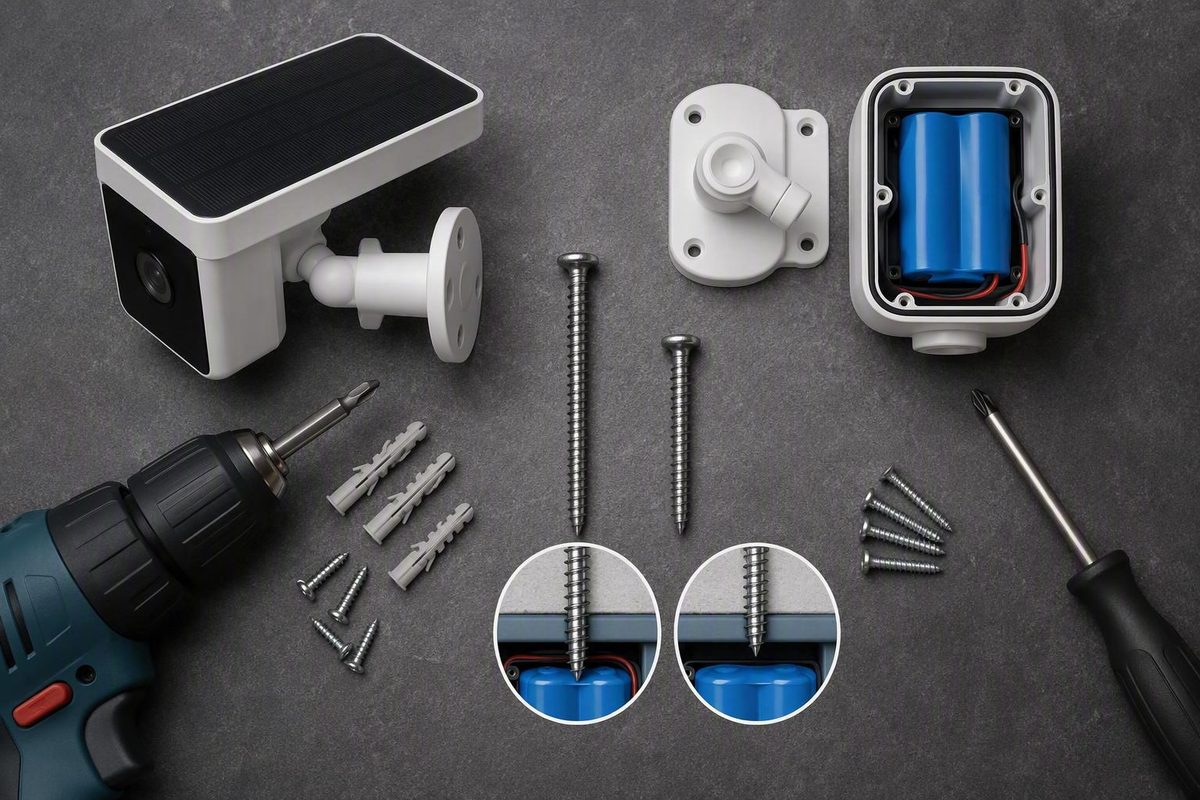
The Wyze Solar Cam Pan recall covers approximately 321,360 U.S. cameras, plus about 2,560 sold in Canada, but the failure is broader than one product: a mounting screw can reach beyond its intended boss and puncture a battery casing. The official remedy is a replacement, refund, or credit—not a DIY screw swap—but checking available depth against screw penetration before installation can expose the same error in other cameras, solar lights, and battery-powered sensors (CPSC recall 26-524).
The Standard Recall Advice Is Correct but Incomplete
The received view is straightforward: identify the recalled camera, stop using an affected installation, submit a claim, follow Wyze’s battery-depletion and disabling procedure, and select the offered remedy. That is the correct response for affected owners.
This is not a case where owners should substitute a shorter screw and keep using a potentially damaged camera. A long screw may already have punctured the internal lithium-ion battery’s metal casing. Removing it from a charged camera could disturb damage that cannot be seen from outside.
The narrow recall coverage is also justified. It applies to the white Wyze Solar Cam Pan, model WYZESCPWH, not every Wyze camera. The model number appears on the back. Wyze’s criteria cover qualifying cameras purchased on or before April 3, 2026, while the CPSC describes a retail sales period from October 2025 through April 2026.
What the standard account leaves unexplained is the mechanical check behind the failure. The instructions allowed a long, flat-head wood screw intended for wall mounting to be installed where a short, pan-head machine screw belonged. The screw could continue beyond the closed-bottom brass mounting insert and into the battery casing. That is a fastener-selection and clearance failure, not evidence that every unit had defective battery chemistry.
The Recall Does Not Publish an Exact Wrong Screw Length
Searches for “Wyze camera recall wrong screw length” suggest that a screw was manufactured to an incorrect dimension. The official record describes something different: installers could select the wrong supplied screw because of incorrect assembly instructions.
Wyze and the CPSC do not publish a numerical length, diameter, thread pitch, or part number for either fastener. The supported distinction is functional:
| Camera-Top Fastener | Description | Status |
|---|---|---|
| Correct | Short pan-head machine screw | Generally no recall action |
| Incorrect | Long flat-head wood screw | Stop use; enter recall |
The short machine screw has a rounded or domed pan head. The long wood screw has a flat or countersunk head and was intended to mount the product to a wall or another surface. Length matters because the longer fastener can reach beyond the intended mounting area, but no authoritative source provides the dimensions needed to reproduce a numerical Wyze clearance calculation.
That missing figure matters. Measurements estimated from photographs, marketplace listings, or superficially similar screws would create false precision. For this camera, identify the screws through Wyze’s official screw-check procedure, not an unofficial length estimate.
Select the Wyze configuration or enter known dimensions for another uninstalled device; the checker identifies which side wins.
The default reflects the recalled Wyze configuration. Exact Wyze screw and boss dimensions are not published, so its result is based on the officially identified fastener and location rather than invented measurements.
Default comparison: long wood screw versus a closed-bottom camera-top insert with a battery behind it. Published numerical clearance: —.
Wyze safety limit: Do not use this calculator to justify removing, repairing, or reusing an affected camera. If its screw type is unknown, use Wyze’s firmware-based depletion and inspection process.
| Configuration | Known Dimensions | Geometry Result | Required Direction |
|---|---|---|---|
| Wyze top bracket, long flat-head wood screw | — | PIERCE RISK | Stop use; official recall process |
| Wyze top bracket, short pan-head machine screw | — | Correct specified screw | No action generally required |
| Wyze panel mounted separately | Not applicable | No camera-top screw exposure | No action generally required |
| Wyze top bracket, screw unknown | — | UNRESOLVED | Do not remove immediately; use Wyze process |
| Other uninstalled device, entering length below boundary | User supplied | SAFE by entered clearance | Verify manufacturer requirements |
| Other uninstalled device, entering length at or beyond boundary | User supplied | PIERCE RISK | Select a shorter approved fastener |
Source: CPSC recall 26-524 and Wyze Solar Cam Pan recall and screw-identification guidance. Wyze publishes screw types and locations but no exact screw length, boss depth, diameter, thread pitch, or part number.
Four Configurations Determine Recall Action
The panel position and fastener type determine the current action under Wyze’s recall guidance.
| Configuration | Current Direction |
|---|---|
| Panel mounted separately | No recall action generally required |
| Top-mounted with confirmed short pan-head screws | Correct installation; no action generally required |
| Top-mounted with confirmed long flat-head screws | Stop using camera; participate in recall |
| Top-mounted, screw type unknown | Do not remove immediately; use Wyze’s process |
These paths identify installations requiring action. They do not establish that every camera assembled with a long screw suffered a puncture. The official warning is that the screw may puncture the battery casing.
If the camera has never been installed, use the corrected instructions. Packaging photographs, retailer listings, videos, and apparently similar hardware do not establish whether a particular screw is suitable.
Wyze says the original package contains three short pan-head machine screws, including one spare. Its guide lists several clues that the long screws may have been installed: unusual turning resistance, squeaking or unnatural sounds, apparent need for a power tool, or two or three short pan-head screws left in the package.
Those signs are warnings, not proof. Resistance is not a substitute for a positive fastener identification, and apparent tightness does not show that the screw stopped safely.
Screw Penetration Must Stop Before the Protected Boundary
For a new, uninstalled product, the useful comparison is not merely nominal screw length. It is the length that will actually enter the mounting point compared with the nearest protected boundary behind the surface.
The basic relationship is: remaining clearance equals the safe available depth minus the screw length that enters the mounting point.
A positive result means the tip stops short by the calculated amount. Zero means the tip reaches the boundary. A negative result means the screw extends beyond it. Where a battery, wire, fluid channel, sealed cavity, or moving component lies at that boundary, zero or negative clearance is unacceptable.
The calculation requires dimensions that are genuinely known:
- Measure the screw from its bearing point to its tip, using the appropriate bearing point for its head style.
- Subtract any length that remains outside the mounting surface because of a bracket, washer, spacer, or unthreaded stand-off.
- Establish the manufacturer-approved usable depth of the boss or mounting material.
- If a protected component is closer than the bottom of that depth, use the component distance as the limiting value.
- Select a screw whose entering length stops short of that limit with an allowance appropriate to the product and installation.
The official Wyze material supplies none of the dimensions needed for steps three or four. Its recalled configuration therefore remains a qualitative pierce risk, not a numerical calculation. Do not probe, open, or measure inside the camera to obtain those figures.
For an ordinary pilot hole in wood or another approved mounting material, a real stop collar can limit bit travel. A tape flag can mark the intended drilling depth, but it is a visual reference rather than a positive mechanical stop. Neither technique makes it safe to drill into a battery enclosure or a surface with unknown wiring or services behind it.
The same clearance comparison applies before mounting a solar light, battery-backed sensor, doorbell, tracker, or compact outdoor enclosure. A screw that threads into a hole is not necessarily suitable for everything behind that hole.
A Long Screw Can Turn Internal Damage Into a Fire Hazard
The camera-top mounting points contain closed-bottom brass inserts. When the long wood screw is driven into that location, it can pass beyond the intended mounting area and puncture the metal casing of the internal lithium-ion battery.
A punctured battery can rapidly overheat, creating fire and burn hazards. The CPSC received 13 overheating reports, including six cameras that exploded and caught fire and six reports of minor burns.
Those categories should not be added together as 25 separate events because the federal notice does not state whether they overlap. They also do not mean every recalled camera overheated or caused an injury. The figures describe reports received in connection with the recall.
The possibility of hidden battery damage is why an affected camera cannot be treated as a routine stripped-screw or wrong-fastener repair. Backing out the screw does not establish that the battery casing is intact.
An Uncertain Camera Must Be Prepared Before Inspection
Do not begin by removing the solar-panel bracket from a charged camera if the installed screw type is unknown. Wyze specifies a product-specific preparation sequence:
- Obtain the specialized battery-depleting firmware through the official process.
- Install it as directed.
- Allow the camera battery to deplete.
- Wait 48 hours as instructed.
- Remove the bracket only after that preparation and inspect the screw heads as directed.
After preparation, rounded pan heads indicate the short machine screws. Flat or countersunk heads indicate the long wood screws associated with the recall.
This is not generic advice to let the battery run down. The firmware, depletion period, waiting time, and inspection order are parts of Wyze’s procedure. If the camera is offline and cannot receive the firmware, contact Wyze before removing or disassembling it. Wyze may recommend free professional assistance in some circumstances, but owners should not assume it is available in every case.
The published guidance does not support opening the camera, touching the battery, recharging a suspect unit, disconnecting internal components, or improvising an electrical method for an offline camera. It also does not provide a universal procedure for packaging or transporting a camera whose battery may have been punctured. Direct those questions to Wyze and the intended disposal facility.
The Remedy Permanently Disables the Camera
An owner with a confirmed or suspected affected installation should submit the official recall form and follow the supplied battery-depletion, disabling, and disposal instructions. Wyze lists three remedies:
- A free replacement camera with a solar-panel accessory.
- A full refund.
- A Wyze gift card or store credit for the original purchase price.
A purchase receipt is not required, according to Wyze’s recall FAQ. For a qualifying direct purchase, Wyze says a refund may return to the original payment method. A qualifying retailer purchase may be reimbursed by check, with a gift card listed as another option.
A camera entered into the recall is permanently disabled. It should not later be reused, resold, transferred, or given away.
That consequence also applies when an owner with confirmed correct screws participates voluntarily because of continuing concern. Wyze says a top-mounted panel secured with the short pan-head machine screws generally may remain in use, but voluntary participation still disables the submitted camera.
Wyze lists recall support at recall@wyze.com and 888-832-7226, Monday through Friday from 8 a.m. to 6 p.m. Central Time.
Recalled Cameras Require Specialized Disposal
A disabled recalled camera containing a lithium-ion battery must not be placed in household trash, curbside or general recycling, or an ordinary retail used-battery collection box.
Owners must follow applicable local and state requirements and attest that disposal has been completed. Before visiting a household hazardous-waste site or collection facility, confirm that it accepts recalled lithium-ion devices, not merely loose household batteries.
Ask Wyze and the receiving facility how to handle, package, move, or deliver a camera that may have battery damage. General battery-disposal advice is not a substitute for instructions addressing a potentially punctured recalled device.
The Installation Error Predated the Final Recall
In an April 14 company notice, Wyze told owners not to assemble or install the Solar Cam Pan while the issue was under CPSC review. The company said setup had been disabled in the Wyze app and explained that installers had confused the long wood screws with the short machine screws (Wyze’s early safety notice).
The finalized CPSC recall followed on June 4, 2026. It identified the affected model and configuration, unit totals, incidents, remedies, and disposal restrictions.
The early installation halt was appropriately broad while the issue was under review. Current guidance is more specific: a separately mounted panel generally requires no recall action, and a top-mounted panel secured with confirmed short pan-head machine screws generally may remain in use.
The recall closes the case for an affected Wyze owner only after the official process is complete. Its reusable lesson comes earlier in the installation: establish what lies behind a mounting point, calculate how much screw actually enters it, and reject a fastener that reaches the protected boundary. Where those dimensions are unavailable—as they are in the public Wyze recall documents—do not replace evidence with an estimate.